Sunday, April 12, 2009

Doordarshan, Mumbai and I

This blog post was prompted by two programmes that I attended in the past fortnight.  The first was the preview screening of the film Harishchandranchi Chi Factory which is feature film biography on the life of the pioneer of Indian films, Dadasaheb Phalke. This was being screened at the Yeshwantrao Chavan Auditorium by the Prabhat Chitra Mandali.

The second was the Vinod Doshi Smruti Mohatsav, a festival of plays in Hindi and Marathi, held at the Ravindra Natya Mandir at Prabhadevi in the memory of the late Vinod Doshi, who was an eminent industrialist and Chairman of the Premier Automobiles Ltd., now known as Premier Ltd. Mr. Doshi had a huge passion for theatre.
At both these venues, I ran into people from the theatre world that were big in the T.V. world in the olden days when there used to be only one channel, the government run Doordarshan. This brought back fond memories of the good old Doordarshan days when one used to sit in front of the only channel available and see everything that it used to dish out.

When we were small, owning a television set was a rarity and I don’t remember when but my grandfather ordered my father to go and buy a television in order to avoid my siblings going to our neighbor’s house to watch T.V. So it was Dyanora a black and white T.V. with a sliding door that came into our house. In days of cable TV and DTH , today’s youngsters and kids would laugh at the bullock cart age we were in where an antenna which was on top of the building terrace/roof had to be adjusted all the time during the rainy season or there was a shake even when a crow sat on it!

Coming back to the people who I met/saw that revived my Doordarshan memories were Girish Karnad who I remember for his role in the serial Khandaan. In fact in his speech he remembered Mr. Vinod Doshi as a person who was very humble and never made them feel that he was a big industrialist helping them. Once when he asked them (Girish Karnad and Arvind Deshpande, who used to run a theatre company) how he could help, he immediately satisfied their big need of a rehearsal space. He gave them a whole floor… around 3000-4000 square feet of space in Walchand Terraces on Tardeo Road, opposite the A.C. Market which they used without any interference for many years.

One more person from the serial Khandaan that I met was Sunila Pradhan. Many will remember her as the wife of the industrialist whose character was played by Sreeram Lagoo. I ran into Chitra Palekar of the Marathi movie Mati May fame which starred Nandita Das and remembered that she and Amol Palekar had directed the serial Kachi Dhoop (Amol had acted in it too) which also starred their daughter Shalmalee. Then there was a bearded gentleman that I couldn't place but later realized that he was the guy who was the newsreader for years in the Marathi ‘Batmya’. His name is Anant Bhave. And sitting in the auditorium I chanced upon Meena Naik who used to host a Marathi children’s programme called KilBil and also Sulabha Deshpande who starred in Choti Baadi Baatein and a host of other serials and Marathi and Hindi movies.

A little history about Doordardhan....Doordarshan was established in India in 1959 but was a part of All India Radio till 1976. Mumbai Doordarshan started transmission in 1972. The color T.V. was introduced in 1982 during the Asian Games and that is when we switched from our black and white Dyanora to the GOI Undertaking produced E.C. T.V.

As watching T.V. was a fascinating novelty, we used to watch everything that came our way. Children’s programme like the Marathi ‘Kilbil’, the Gujarati “Santakukdi’ and the English ‘Magic Lamp’ were very popular amongst us. Then programmes like Amchi Mati, Amchi Manse for farmers, Phool Khile Hai Gulshan Gulshan, a talk show in the seventies aka today’s Coffee with Karan hosted by Tabassum, Chhayageet a programme with a medley of Marathi/Hindi film songs that later became Chitrahaar, the famous Chimanrao starring Dilip Prabhavalkar of Munnabhai fame which was a show based on C V Joshi’s short stories, the Baban Prabhu-Yakoob Sayeed comedy show and ‘Gajra’, a Marathi entertainment programme. There would be one Marathi and one Hindi film shown every week in the evening either on Saturdays or Sundays. Then there was Sports Round-Up hosted by Fredun Divitre.

My grandfather used to watch Batmya everyday at 7:30 pm. I remember Bhakti Barve, Pradeep Bhide and Anant Bhave who were regulars at Batmya. It is said that Smita Patil too started her career by giving the Marathi Batmya. It was preceded by Udyache Karyekram, a schedule of the programs that would be held the next day. Saptahiki used to show a schedule of programmes for the next week. I wonder if they still show Aapan Yaana Pahilat Ka, a flash of people who went missing. This must have done a great service to the families of missing people and I wonder if any of the channels today would do this community service. Lots of shows used to be shown featuring classical programmes. There were also some English shows like What’s the Good Word with Sabira Merchant, Fire Ball XL5 and Der Alte – The Old Fox. These were days before the arrival of the T.V. serials or soaps.

The first serial that became a huge hit was Hum Log and later Buniyaad. I remember that when they were airing the last episode of Buniyaad, we had to go for a wedding at the Taj Mahal and hurried back to catch the episode wondering on the way why there were no lights anywhere on the way home. We realized that we had foregone the ice-cream at the Taj for nothing as Bombay had no electricity and was blacked-out due to the tripping of some grid. Then there were hundreds of serials that you would remember as they became very popular. Yeh Jo Hai Zindagi directed by Kundan Shah with Kishore Kumar’s title song and starring Shafi Inamdar,Swaroop Sampat, Rakesh Bedi, Satish Shah and Tiku Talsania and the dialogues “thirty years ka experience’ and “yeh kya ho raha hai’ were on everyone’s lips. Two other serials that I remember very well were Chunauti and Subah which were shot in my college, the Wilson College at Chowpatty. Many of my college mates had acted in them as there were auditions held at the college itself. The serials were on college life.

Ados Pados, a serial directed by Sai Paranjpe of Chasme Baddoor/Katha fame was truly hilarious. It was about life in a housing colony and I remember a family had six kids whose names were A, Ba, Ka, Da, and E like the first five letters of the Marathi Barakhadi. Then the carrot chewing Karamchand, a detective serial with his assistant Kitty starring Pankaj Kapoor and Sushmita Mukerjee. Nukkad, the serial with a medley of characters touched upon issues faced by the common man and Rajani made Priya Tendulkar immortal when she took up various civic and social issues. Kachi Dhoop which featured a young Bhagyashree Patwardhan had Ashutosh Gowarikar as her boyfriend in the role of a tuition teacher! Khandaan was a good drama series on an industrial family and starred Sriram Lagoo, Sunila Pradhan, Mohan Bhandari, Girish Karnad, Neena Gupta, Rohini Hattangadi, Shekhar Kapur and Jayant Kriplani. Quite a full house. Surabhi took you on a travel and cultural. journey with Siddhartha Kak and Renuka Shahane.

I loved a Marathi serial called Shwetambara that ended very abruptly, another one called ‘Gotya’ and Ek Shoonya Shoonya based on crime. Of Course, Ramayan and Mahabharat brought life on the streets to a standstill. The World This Week on Friday nights hosted by Pranoy Roy (NDTV) was very popular as he showed a snippet of news and information from around the world.

Then there were so many others that I will just list like Idhar Udhar, Mr Mrs, Ek Do Teen Char, Wah Janaab with Shekhar Suman and Zarina Wahab, R.K. Narayan’s Malgudi Days which till date is a popular ring tone, Star Trek, Choti Baadi Batein, Udaan which made Laltaji urf Kavita Chowdhary very popular, Gul Gulshan Gulfaam, Wagle Ki Duniya starring Anjan Srivastava and Bharati Achrekar, Bharat ek Khoj based on Nehru’s Discovery of India, Chanakya , Dekh Bhai Dekh, Isi Bahane, Jaspal Bhatti’s flop show, Bikram aur Betal, Paying Guest, Mr. Yogi with Mohan Gokhale, Zabaan Sambhaal Ke,

Lastly there were English Serials mostly British which one can see on BBC Entertainment. I loved serials like Fawlty Towers, Are You Being Served, Some Mother’s Do Have’Em, Different Strokes, Mind Your Language, Remington Steel, Spider-Man, He-Man, Body Line, Sandokan (Kabir Bedi) and all the cartoons and one that I hated was the Didi’s Comedy Show.

Many of the actors in the above mentioned serials have become big stars and well known character actors in Bollywood and some sadly passed away, many prematurely. These include Priya Tendulkar, Mohan Gokhale, Bhakti Barve, Smita Patil, Arvind Deshpande, Dilip Kulkarni, Manorama Wagle, Shafi Inamdar, Chandrakant Gokhale, Shankar Nag, Sudhir Joshi, and Laxmikant Berde. Gone are the Doordarshan days with their passing.

Tuesday, April 07, 2009

Amaltas


This was the first Amaltas (Cassia fistula) blooming that have I sighted upon this year. This beautiful tree is located right at the middle of the Mint Road junction not too far from Ballard Estate. Amaltas is one of my favorite trees and I long to see them bloom at this time of the year. It is also called the Indian laburnum, not to be mixed up with the Laburnum trees of the famous Laburnum Road at Gamdevi. It is also called the Golden shower tree and is indigenous to India.

The first time I had seen an Amaltas tree was many years ago in Pune, near Kothrud and it had shed all its leaves and was in full bloom. It was not a very big tree and so looked very delicate with beautiful golden-ish yellow flowers that resemble grapes hanging from the branches. The tree remains leafless for a period between March and May. You may not even notice this tree at other times of the year when it is not blooming.

I guess the Amaltas has a lot of fan following. Here is a detailed post from another Amaltas fan. Like this one, everyone thinks that Gamdevi’s Laburnum road is lined with Amaltas trees but they are not the Amaltas but Laburnums imported from England. The Amaltas tree is said to a cousin of the English Laburnum. It is believed that Gandhiji used to gaze at these Laburnum trees from the Mani Bhavan which is located on Laburnum Road at Gamdevi. If you want to know more about Laburnum Road, read Windy Skies excellent post on the same.
Historian, Sharada Dwivedi too had an excellent tale to tell. She has been quoted in the Indian Express, “A few years ago some of the wiser citizens had decided to rename the famous Laburnum Road near Gamdevi, under the impression that it was named after some Englishman. Only at the eleventh hour the BMC came to know the road was named after the Laburnum tree that used to grow in that area, and a big bloomer was averted.''

I have seen many Amaltas trees all over Mumbai including one near the Eros theatre and at the B P T Park at Colaba. If you spot any others around, do let me know.

Tuesday, March 10, 2009

Lest I forget

Last year, many strays that I knew passed away. Most of them were dogs that were old and had lived a good life on the street. They were looked after and cared for by someone. It becomes very tough when you lose a pet and for me it has always been tough to lose so many that I have known over the years. All these were strays that I had interacted very closely with and grown very fond of. This blog is dedicated to all of them.

The Nariman Point Kalu: The Sunday after the 26/11 terror attacks, I was in Nariman Point administering first-aid when a man who recognised me came running shouting "Doctor, Doctor ... Kalu mar gaya”. I asked him what had happened and he said “terrorist’s ne mar diya” and went onto describe how it happened. As I wondered how the terrorists could have been at Nariman Point… I realised later after reading newspaper reports about the terrorist attacks, that the man was telling the truth. I pieced together the man’s inputs with the newspaper reports on what could have happened.

After the terrorists had hijacked the police van from Metro and driven towards Nariman Point with a burst tyre, Kalu started chasing the vehicle as it was making a terrific noise. This happened at the traffic circle near the Mittal Towers. This was when the terrorists gunned him down, proceeded ahead and later took over the Skoda. The man, who met me told me that Kalu died instantaneously, had suffered bullet injuries and that they buried him near the sea.

The WIAA Kalu: I have known him ever since I started doing first aid in 1996. He died on January 23, 2009 at the WSD kennels of old age, when I was in Delhi for our Supreme Court case. Kalu was one of the most happy and resilient dogs I have known. He used to live in the Indian Merchant Chambers building at Churchgate where Irani Café, Stadium Restaurant is located. He was called the WIAA Kalu as one of the WIAA (Western India Automobile Association) drivers had brought him as a puppy sixteen years ago and all the WIAA drivers and staff used to love him and feed him. He was friends with Raju another reddish brown hairy dog who used to live here and died some years ago. Kalu was very affectionate. You would see him lying down near the 123 bus stop or on the footpath outside the IMC building. He used to make these bawling sounds on seeing me and wanted to be petted continuously. In his hey days, he would follow me to a point and then go back. Kalu has been through many maggot wounds, a liver problem, an accident where he was paralyzed but he came out strong. Whoever knew him, loved him including WSD volunteer Urvi Desai who had taken the photo that I have used alongside. Kalu was not very happy when they brought Rani,a bratty puppy to his 'ilaka' and used to act snooty with her at the beginning. He of course accepted her in some time. Rani still lives there but has glaucoma and must be missing Kalu like all of us.

Altamount Road’s Jimmy: I had known Jimmy for atleast twelve long years. Jimmy used to live in some tenements opposite the Washington House on Altamount Road. He was looked after by Rakesh who worked with Smoking Joe’s Pizza. I must confess that Jimmy was one of the few dogs that has bitten me. He used to hate me from the bottom of his heart for all the rabies immunization pokes and the maggot wound and other treatment given to him. It used to be easier to treat him when Rakesh was around , so we used to visit Jimmy during Rajesh's off-duty hours. During one such visit for a rabies vaccination, he must have though that this was his chance to take ‘badla’(revenge) and gave me a small bite on my leg when I turned around to leave.

Little did we know that when WSD volunteer,Rohan Mukerjee photographed him for the WSD 2009 calendar, he would not be around when it came out. Though he was street smart, I was very shocked to know that he was run over. He was one of the oldest dogs on this street and shared the tenement with Junior, a young reddish hairy dog.


The Rhythm House Kali: Kali too was very old, around sixteen. She used to live outside the Rhythm House at Kala Ghoda and used to be looked after the street dwelling family living on that foot-path. Kali used to be loved by all the street kids who also used to lovingly sit on her and she used to never protest. She too used to try and slink away when she saw me or when we had to treated her for any ailment; she used to give us a little chase upto the Kala Ghoda parking lot. She was the last of the many dogs that this street dwelling family has and younger ones had passed away before her. This photo was taken when one of the street kids wanted to put some X'mas decoration over her and she was getting ready to dart off on seeing me. The other one is of her, feeling at 'home', outside Rhythm House.


The ‘D’ Road Moti: Moti was a favorite with all the residents of Vishnu Mahal on D road at Churchgate and he used to take turns of going to different people's houses on various floors of the building for a hearty meal. You, thus would not have been surprised seeing his size. He was really huge. He used to be a good guard dog in the building and always watched me suspiciously when we used to go to give him his annual rabies vaccinations or treatment. Moti was atleast fifteen and died of liver failure and was given a tearful adieu by the Vishnu Mahal residents and me at the animal hospital crematorium.


Fashion Street Rocky: He used to live on Fashion Street not very far from The Bombay Gymkhana. He was brought there thirteen years ago by the street dwelling family whose one son still runs a cutting chai outfit on the foot-path at the entrance to Azad Maidan. Rocky was black with ‘dobe’eyes. He used to go berserk on seeing me and used to jump up and down literally trying to reach upto my chin. A volunteer who was doing a photography project had clicked a photo of him jumping in mid-air at me. Rocky has had his share of maggot wounds and the bald patch on his head was due one such terrible maggot wound which WSD’s volunteer from Germany, David Murphy had cured. Rocky was like a cat with nine lives. Some years ago, one day whilst passing by, I found him in a terrible condition, listless, not able to get up and with a very bad maggot wound. He was taken to the WSD kennels and over time, he healed and was happy to be back. Rocky would generally be lazying around on the edge of the Bombay Gymkhana grounds, on the Azad Maidan or between the parked motorcycles on the Fashion street foot-path. When ever I am passing his hide-outs, I wish that he would mysteriously appear from some where and greet me with his signature jump. Here is a photo of Rocky and his Maidan friends.


The Parsi Kua Rani: She was the gentlest dog that I have ever known. She used to live at the Parsi Kua or the Bhikaji Behram well, near Fountain. She has been living there for the last fifteen years and she was a very gentle dog loved by the Parsi worshippers who visit this holy place and of course the attendants who doted on her. They were always very concerned about her and used to call WSD very promptly if she was suffering from any ailment. She used to either be sitting at the door under the photograph of Zarathustra or on one of the green wooden benches or somewhere near the well. She was a very willing patient, be it for her tick infestation or her rabies immunization. She will be truly missed by all of us.

To be continued.....

Photo Credits :

Jimmy: WSD Volunteer,Rohan Mukerjee...taken for the WSD 2009 Calendar.
WIAA Kalu : WSD volunteer, Urvi Desai

Saturday, February 28, 2009

Strand's Shanbhag passes away


Mumbai sure will be left with a vacuum in the world of book sellers and books with the passing away of Mr. T N Shanbhag, founder and owner of The Strand Book Stall at Fort. Mr. Shanbhag expired yesterday(February 27, 2009) at 1:30 pm and was cremated at the Chandanwadi crematorium at 11:00 pm.

Many know that Mr. Shanbhag started his book stall as a kiosk in the erstwhile Strand Cinema (thus the name) in Colaba on November 20, 1948 and moved it to its present location in 1954. Geeta Chadha who has written a chapter "Mirroring the Precinct", in the book Zero Point Bombay on The Horniman Circle precinct writes: "Having been humiliated in a reputed bookstore of the time for touching a book, the young Shanbhag wanted to start a bookstore where the access to ‘Saraswati' would not be restricted to the elite, but would be open to a wider section of the people. Shanbhag approached Keki Mody, the owner of Strand Cinema with his idea, and that is how the Strand Book Stall came into being on the premises of the cinema hall." Ths idea came to him during the screening of "Cheaper by the Dozen" at Strand Cinema.

Ask any book lover, reader, aficionado,buff,bookworm and he would have many names for the Padmashree Award winner of 2003 … favorite book seller, saint of books, twinkle eyed gentleman, humble book man of Mumbai and so on….

I knew him from all the frequent visits, over the years to the Strand Book Stall and also because his wife’s sister who we lovingly called ‘Mau’ was our next door neighbor. I remember him telling me that he was the first one in the world to sell a book at a discount (that too of 20%).

I have seen him, many a times forego much more than 20% for students and others who did not have enough to cover the bill. The additional book was always thrown in. This would never have happened in any other book store. He always used to say that Saraswati can never be bought or sold. He had in-depth knowledge of any book that you wanted which made you feel that he must have read each and every of the lakhs of titles in his store and I am sure he must have.

People used to throng and look forward to The Strand Book Festival at Sunderbai Hall held in January of every year, where discounts used to be higher and one could get ‘real’ deals on many books(Strand Specials). This was the first year that I did not see him at the Book Festival and his wife mentioned to me that he was at the Cumballa Hill Hospital but was recovering.

Last week, I had attended a lecture by Dr Frank Conlon on the Books Sellers and scholars of Bombay and any such discussion would have been incomplete without the mentioning of Mr. Shanbhag. In fact, the Mumbai book scene is going to be incomplete with the passing of Mr.T. N. Shanbhag. Mumbai has lost a city institution and a precious part of itself. Mr. Shanbhag will truly be missed by the city especially by those like me who have spent hours browsing in the little book store wth a soul.

Read Ranjit Hoskote's article"Honouring the bookman" written for the Hindu in 2003 here

Thursday, February 26, 2009

The whole slum knows Gachkya


I have known Gachkya for the past twelve odd years. The first time we got a call for a dog with a skin problem, the caller said “woh, mutari mein baitha hoga”. (He will be sitting inside the Urinal*), aur uska naam hai Gachkya”. (And his name is Gachkya).

He was called Gachkya because of his skin problem. The first time I remember being overpowered by the ammonia smell, having to carry out Gachkya who was sitting in the corridor of the Urinal and treat him. Promptly after being treated he would run back to occupy his position.

So it became a ritual if Gachkya was on the first aid list to go to Nariman Point, checking first in the toilet where he would be always sitting, being overpowered by the ammonia smell, carrying him outside, treating him and seeing him trot back right into his toilet. This carried on for years and recently he has thankfully moved into the narrow gullies of the slum behind the toilet.

He has always been a very sweet and quiet dog allowing us to carry him around for want of a better position for his treatment. He always does a little run of the criss cross gullies just to tease us, wagging his tail in tow. It is a game that he has mastered over the years. People never ‘shoo’ him away no matter where he is sitting, inside the Urinal or in the slum gully.

Gachkya is a resident of the slum opposite Tulsiani Chambers in Nariman Point and last Sunday when I saw him, he was as patient, as quiet, as friendly and as sweet as ever. Gachkya must be at least fourteen years old.

* Urinal here means a toilet with only urinal facilities.

Also cross posted on Mumbai Street Dog Photos

Monday, February 23, 2009

Shere Khan


In Marathi, a cat is called ‘Waghachi Mavshi’ or a tiger’s aunt. Well, here is a white cat that is true to his name. Shere Khan hangs around with some hawkers who sell shoes and socks on the P M Road footpath. He loves sitting on the cycle seat and will pose for you when you flash your camera. According to one of the elderly hawkers there, Shere Khan appeared one fine day, five years ago and took to all the hawkers who dote on him and feed him.

So next time if you are on P.M. Road in Fort, look out for this white ‘tiger’ who would be sitting on a bicycle allowing you to pamper and admire him at the same time.

Wednesday, February 18, 2009

Bombay's Book Stores - Old and New

Today, when I saw Dr Frank Conlon at the Durbar Hall at the Asiatic Society, I remembered where I had seen him last. It was at the St Xavier’s College in February 2007 where he was giving a lecture on The Tramways of Mumbai. This time, he was talking about “Bombay’s Book Sellers and scholars”, a talk organized by The Asiatic Literary Society.


Dr Frank has written many Bombay centric articles including "Dining Out In Bombay", "Industrialization and the Housing Problem in Bombay, 1850-1940” and the book, "A caste in a changing world : the Chitrapur Saraswat Brahmans, 1700-1935".

He first came to Mumbai in November 1965 and frequented many book stores and libraries. He remembers book stores like Taraporewala and Sons and New Book Company on D.N. Road, Thackers and Chetana on Rampart Row, Alavi Book Depot and Kokil on Mohammed Ali Road, N.M. Tripathi on Princess Street, New and Second Hand book store at Kalbadevi, Popular Book Depot on Lamington Road and Bombay Book Depot at Prarthana Samaj and the Strand Book Stall in Fort.

He says that the above stores were started by people who had genuine appreciation of books. Real books shops are an ‘endangered’ species today and various compulsions have closed down many including Popular, Bombay, Thackers, Alavi and Kokil.

He added that today’s bookstores like Crossword might be fancy, have sofas, carpets, air-conditioners and coffee shops but the people working there have ‘no engagement with the product’ and going to such stores is not the same for those who feel and have a special affection for books.

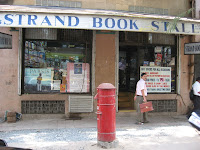
Strand Book Stall

He spoke about some of the people behind the stores. Everyone knows about Mr. Shanbhag of the Strand Books Store. He didn’t go into the details but here is an extract from my post on the Strand Book Festival. “It all started when Mr. T. N. Shanbhag (recipient of the Padmashri in 2003) put up a little stall which sold books at a discount. It was located near the erstwhile Strand Cinema (thus the name) in Colaba and opened on November 20, 1949 and was moved in 1954 to its present location. Mr. Shanbhag was telling me all this and added that he was the first one in the world to sell a book at a discount (that too of 20%)”

Popular Book Depot

He then spoke about the Popular Book Depot and G.R. Bhatkal and his son Sadanand. The Bhatkals were seen as the pioneers of the book and publishing business.

I have had the good fortune of knowing Sadanand kaka as I call him and remember going to the green painted Popular Book Depot on Lamington Road as a kid. The store had a long counter and perpendicular to it, at the back were rows of shelves full of thousands of books. I remember going past these rows to the back and climbing onto a steep ladder to go to Sadanand kaka’s office.


Popular book depot was started by Sadanand Bhatkal’s father Shri Ganesh Bhatkal in 1924. Eminent jurist , the late Nani Palkhiwala in a speech rendered for a G.R. Bhatkal Memorial lecture in September 1995, says that Shri Ganesh Bhatkal helped him in three inestimable ways. He used to allow Mr. Palkhiwala to treat Popular as a public library. During his career as an arts student(1936-1942), he was allowed to sit and browse through books at the shop for hours together and also take home books ‘on approval basis’. He also remembers that he would at times continue reading even after the front door had been closed and later coming out by the back door.

I was truly saddened when Popular closed down in the eighties and so did Bombay Book depot which was a leading Marathi book shop. In fact, Sadanand kaka’s brother Ramdas kaka that ran Popular Prakashan, a publishing house was present for Dr Conlon's lecture.

Dr Conlon ended his lecture by mentioning scholars and institutions that have made a big difference in researching various subjects on Mumbai and feels that today there is an upsurge on the number of people who want to research on Mumbai.

Stores that are still around

Mumbai has various books stores where you can satiate your literary appetite. The new age book stores like Crossword with their flagship store at Kemps Corner and many branches all over,Granth at Goregaon and Juhu, Oxford at Churchgate and the newly opened Landmark at Andheri. All these and the various neighbourhood book stores

There are niche book stores like Marine Sports Books Store at Dadar for sports books, Computer Book Shop on D.N. Road for computer books, Sterling Book Shop at V.T. for management books,Gandhi Book Centre at Nana Chowk for books on Gandhiji,Hindi Granth Karyalaya at C.P. Tank for Hindi books , Ideal book depot at Dadar and Majestic at Girgaum for Marathi books, Lakhani Book Depot at Girgaum for text books and Bhavan's Book stall at Chowpatty and Andheri for Religion,History and Phlosophy.

Single books stores which have been around for a long time like Danai at Khar(which also has opened a branch at the Taj Land's end), Nalanda in the Taj Mahal Hotel at the Gateway of India, Shankars outside Cafe Mondegar on Colaba Causeway and Causeway Book Store which sell books left behind by foreign tourists at over-rated prices.


And the old age ones like the Strand , off P.M. Road, FBH ( Fort Books Distributors) at V.T. who supply a lot of books to all the Mumbai book stores and regularly hold exhibitions all over the city. You would get new and second hand books at the New and Second hand books shop at Metro, Smokers Corner at the Ballard Estate end of P.M. Road and of course the road side book-sellers around Fountain, Churchgate, King's Circle, Bandra and at 'raddiwalas' all over the city. All these stores would always give you discounts on the books.

But in the sea of the Crosswords, Oxfords, Granths and Landmarks … the Strand remains my favorite.