
Showing posts with label MUMBAI. Show all posts
Showing posts with label MUMBAI. Show all posts
Thursday, April 21, 2011


Wednesday, March 23, 2011
The Mumbai Twestival 2011

The Welfare of Stray Dogs(WSD) has been chosen as the NGO from Mumbai in the Twestival Local 2011 - an annual event that encourages local groups of Twitter users to raise money and awareness in aid of their favorite charities.
Twestival was born out of the idea that if cities were able to collaborate on an international scale, but work from a local level, it could have a spectacular impact. Since 2009, over 200 cities have participated by hosting offline events raising close to $1.2 million for 137 causes; most notably education and clean water.
Now, we need your help to spread the word and raise funds. GiveIndia, the online fundraising partner, will be offering additional money to the city/NGO that raises the most and has the most donors. So far, over Rs.10,000 has been raised but we can do more.
You can donate as little as Rs.110 or as much as you’d like. Here’s the link: http://www.giveindia.org/give/
What else can you do?
1. Put the link and this message as your Facebook status:
Twestival was born out of the idea that if cities were able to collaborate on an international scale, but work from a local level, it could have a spectacular impact. Since 2009, over 200 cities have participated by hosting offline events raising close to $1.2 million for 137 causes; most notably education and clean water.
Now, we need your help to spread the word and raise funds. GiveIndia, the online fundraising partner, will be offering additional money to the city/NGO that raises the most and has the most donors. So far, over Rs.10,000 has been raised but we can do more.
You can donate as little as Rs.110 or as much as you’d like. Here’s the link: http://www.giveindia.org/give/
What else can you do?
1. Put the link and this message as your Facebook status:
Help the Welfare of Stray Dogs win the Twestival by donating Rs.110 today!
2. Tweet the link to your followers http://www.giveindia.org/give/
3. Write a blog post about the Twestival.
So, donate now and spread the word so that we get the maximum support for the Welfare of Stray Dogs. Let’s reach out and help the stray dogs of Mumbai!
2. Tweet the link to your followers http://www.giveindia.org/give/
3. Write a blog post about the Twestival.
So, donate now and spread the word so that we get the maximum support for the Welfare of Stray Dogs. Let’s reach out and help the stray dogs of Mumbai!
Also do come for the Mumbai Twestival Event
Venue : Wtf, Khar, Mumbai
Date : 24th March,2011. Thursday.
Time: 7pm - 10 pm.
Entry fee is Rs 300 and above. So pay it to http://bit.ly/giveMumbai or you can pay it on the spot. Get a guest or two along.
Here are the links.
On facebook : http://www.facebook.com/event.php?eid=198610060159079
On twitter : http://twtup.com/MumTwestival11
Show us your support and be there.
If you still want to help us out, send a shout out to @mumtwestival or an email to rashiv@gmail.com
And big Woof here and see you there.
Photo Credit : Rohan Mukerjee for The WSD-Strays of Mumbai Calendar 2010
Photo Credit : Rohan Mukerjee for The WSD-Strays of Mumbai Calendar 2010
Sunday, January 02, 2011
First Aid Sundays with street dogs and humans
For almost close to the past 15 years, The Welfare of Stray Dogs(WSD) volunteers meet outside Eros theatre to group and split up... to treat various cases of street dogs and cats that require basic first-aid as a part of WSD’s on-site first aid programme. I must have been there on eighty percent of the Sundays in the last fifteen years after having initiated this programme.
Though to the non-animal loving world, this seems to be an activity involving street dogs; it is much more than that. It also becomes a long term association with the people who look after the street dogs. These are all kinds of people; the boot-polishwala, the driver, the street-dweller, the traffic policeman, the housewife who feeds dogs, the hawker, the rag picker and thousands of Mumbaikars who live on the Mumbai streets. Whilst treating dogs, we peep into their worlds and become privy to their sadness and joy.
Today as I was about to start on my first case at the Oval Maidan, I felt sad with the phone call I received. The person on the other side asked me if I knew a driver called Karunakaran Pillai. I thought it was a wrong number and as I was going to tell him so when another person came on the line and identified himself as a Police Inspector. A man named Pillai had just died and my number was found in his telephone book. They were calling up people listed on his telephone book to search for his relatives. I then realised that it was the Pillai I knew and I was confused because of the name Karunakaran. He used to be a driver and used to call us for help for strays that he used to look after. Abodh Saar is how he addressed me. He used to liberally hand out our number to others like him who needed help for street dogs in distress or himself report them to us. He used to live near the Old Customs House and must have called us scores of times. In fact, I had run into him about a month ago in the by-lanes of P M Road. He had a favourite dog called Soorya who passed away some years ago.
There are so many like Pillai who we have been fortunate to know because of the street dogs, many of them who live alone and then the street dog becomes their only faithful companion and someone they can interact with in this busy city. Many like Pillai pass away unknown and unsung, to be recorded as just another death amongst the lakhs in this city.
Coming back to Eros theatre, we started meeting here because of Arvind, a shoe shine man(boot-polishwala) who used to live and work outside on the footpath of the theatre. He loved street dogs and used to name them after the movies that were playing at that moment at Eros. He had a James (James Bond), a Pretty (Pretty Woman), a Hritik and an Amisha (Kaho Na Pyar Hai). Everyone around Eros knew him well and used to call him Bangali. He too died some years ago, again with no relatives and after many trips to the J J Hospital. All his dogs had died before him, other than the Pomeranians left in his care by a lady who took them back after he died.
So we continue to meet at Eros theatre every Sunday morning and are greeted by Mini aka Julie, a white and brown dog that needs to go on a diet. She is the friendliest dog I have seen and has a severe attention seeking disorder. She loves being patted all the time and if you stop she will nudge you to carry on. She hangs around the area, is looked after by another shoe shine man and on week days I spot her sitting outside the new French restaurant opened in place of Sundance.
 |
| Sallu from Oval Maidan |
Next case was Orange, looked after by the watchmen of the now closed Shellys Hotel diagonally opposite the Radio Club, close to The Gateway Of India and Taj Mahal Hotel. She has a skin problem and when we call out Orange
And then we came to Kalu, a fat obviously black cat which we never find on Sundays as he would be in hiding. He is looked after by the Kapoor Lamps people at Kala Ghoda and you will find him on week days sprawled across its entrance. He wanders around the lanes between Fab India and Rhythm House and ask the newspaper vendors, food and other hawkers, they would all know about Kalu and tell you that his majesty just passed by.
And then was Rambo who lives in the open compound in the Great Western building. near the Apollo Gate. A toughie in his younger days, he used to give me a tough time treating him. He used to run into the pump room when he had a bad maggot wound and growl away. Today, age has caught up with him and it was easier as I could just catch him and treat his ear and leg which was maggoted but now is a wound that is healing. An old Gujarati lady, who is very fond of him, directs us to where he would be. She is generally always sitting on a charpai in the compound and will talk in Hindi with a predominantly Gujarati accent assuring us that Rambo will not bite, which of course he doesn’t.
Next, were four dogs in the vicinity of the Sterling theatre. The first Rinku looked after by Tulsi Akka who lives on the footpath opposite New Excelsior theatre. She calls me Abodh baba and I know her for the past 15 years having looked after all her dogs (past and present). See Ramesh in this link. Rinku too had maggots in the ear and she starts running at my sight and smell. The others cases in the vicinity are Chowpatty and Byculla named such as they were brought by the kids from Chowpatty and Byculla.
We then come to treat Rajan’s dog Tiger who we had found after a girl reported finding a pup in a local that had just pulled into CST station. We knew Rajan was looking for a dog as his earlier dog Ronnie who was a Pomeranian had just passed away. Rajan and his wife live in a little hut surrounded by recyclable material. Rajan is a rag-picker. When we have to treat his dogs, we would be sitting amongst sacks of segregated paper cups, glasses, plastic, newspapers, bottles and what not. Rajan too has a sad story; he named his dog Ronnie after his son who died in tragic circumstances when he was just two. He used to always tell us that the Pomeranian Ronnie is now his son. He was very upset when the Pomeranian Ronnie who was around ten years old died after getting Ascitis. His wife too passed away last year (2010) and that really changed him. I seldom see him smile now and you can see it in his eyes that he misses her and thinks about her all the time. He now lives alone with two dogs, another Ronnie and my good 'friend', the barking Tiger.
Then was good old’ Brownie who lives outside Lakshmi building on P M Road. He has a maggot wound near the anus and today, I could treat him without having to chase him as he was fast asleep when we approached him. Once, many Sundays ago, to the delight of other WSD volunteers, he had made me chase him all around P M Road right past Bombay Store upto the French Bank building and back. And remember he is fifteen years old.
As we were treating him, a crowd collected and one of the street dwellers who were busy playing a Sunday card game on the Lakshmi building steps screamed out to the crowd “Yaha pe shooting nahi chal raha hai, Shooting dekhana hai to Horniman Circle garden jao, waha chalu hai” (There is no show on here, if you want to see a show, go to Horiman Circle garden where there is a film shooting going on). The poor old fella patiently allowed us to treat and deworm him.
As we were treating him, a crowd collected and one of the street dwellers who were busy playing a Sunday card game on the Lakshmi building steps screamed out to the crowd “Yaha pe shooting nahi chal raha hai, Shooting dekhana hai to Horniman Circle garden jao, waha chalu hai” (There is no show on here, if you want to see a show, go to Horiman Circle garden where there is a film shooting going on). The poor old fella patiently allowed us to treat and deworm him.
The last case was a severe skin problem on Gunbow Street Orange
I am sure that I will continue meeting and building relationships with many such Arvinds, Pillais, Rohidas and Rajans who never in my past fifteen years of treating street dogs have asked me “ Why are you doing it for the dogs”, Why not us ! They understand why, some others don’t. And those who don’t are never the underprivileged!
Tuesday, May 04, 2010
And Mumbai's lifeline is being pulled by an engine !


These photos taken by me at 8:30 am today of a local train running slowly and is being pulled by an engine. This is between the Grant Road and Bombay Central stations on the Western Railway during peak commuter hours and it sums up "The Motormen's Strike' which paralysed Mumbai yesterday and would continue to do so today unless it is called off.
Read reports about the strike which is the biggest since 1974 , here here and here.
Friday, March 05, 2010
Kipling at the J J School of Art.

When I was in school, I used to go into the dean’s bungalow in the campus of the Sir J J. Institute Of Applied Art and collect ‘gunja’ or the red beads that fell into its compound from the red sandalwood / bead tree also referred to as Ratangunj in Marathi. In olden times, it is said that goldsmiths used to use these red beads as weights.
My visits were because of the fact that I studied at the next-door St Xavier’s High School and used to visit my sister who was a commercial arts student at the

Rudyard’s father, John Lockwood Kipling was the first Principal of the J.J. School J.J. School School Of Architecture India , Prince Of Wales Museum (now Chattrapati Shivaji Maharaj Vastu Sangrahalaya), G.P.O., Institute of Science , The Small Causes Court and Wadia and K.E.M Hospitals
Here’s what Kipling wrote about
The Cities are full of pride,
Challenging each to each --
This from her mountain-side,
That from her burthened beach.
They count their ships full tale --
Their corn and oil and wine,
Derrick and loom and bale,
And rampart's gun-flecked line;
City by City they hail:
"Hast aught to match with mine?"
And the men that breed from them
They traffic up and down,
But cling to their cities' hem
As a child to their mother's gown.
When they talk with the stranger bands,
Dazed and newly alone;
When they walk in the stranger lands,
By roaring streets unknown;
Blessing her where she stands
For strength above their own.
(On high to hold her fame
That stands all fame beyond,
By oath to back the same,
Most faithful-foolish-fond;
Making her mere-breathed name
Their bond upon their bond.)
So thank I God my birth
Fell not in isles aside --
Waste headlands of the earth,
Or warring tribes untried --
But that she lent me worth
And gave me right to pride.
Surely in toil or fray
Under an alien sky,
Comfort it is to say:
"Of no mean city am I!"
(Neither by service nor fee
Come I to mine estate --
Mother of Cities to me,
For I was born in her gate,
Between the palms and the sea,
Where the world-end steamers wait.)
Now for this debt I owe,
And for her far-borne cheer
Must I make haste and go
With tribute to her pier.
And she shall touch and remit
After the use of kings
(Orderly, ancient, fit)
My deep-sea plunderings,
And purchase in all lands.
And this we do for a sign
Her power is over mine,
And mine I hold at her hands!
Gillian Tindall in her book, 'The City of
Another Rudyard Kiplings’ Mumbai connection is that of the beautifully sculpted marble panels in bas-relief on the Crawford market and the decorative panel of tutelary animals and the Indian River Goddess on the fountain inside the Crawford Market. They were crafted by Rudyard Kipling’s father, John Lockwood Kipling.
Coming back to the bungalow, currently it is lying vacant and there was some talk about it being converted into a Museum but not naming it after Kipling. Hope they preserve the bungalow and if you have the time take a stroll into the beautiful
Monday, July 06, 2009
Mumbai Birds - The Crow
The baby crow sat in my hand and clutched onto to me. His disproportionate huge head to his little body did not take away his defense mechanism in opening his big beak wide open, every time I petted him on the head. After a while he got used to me and sat quietly in the taxi-ride from opposite Mani Bhavan at Gamdevi to Fort.


I was attending one of the hundreds of calls in the year that WSD receives to rescue city-birds….mostly crows, pigeons, cuckoos, owls and kites, sometimes parrots, sparrows, egrets and herons. I am not a bird-enthusiast and cannot distinguish a heron from a magpie …but yes I love our everyday city birds.
The Indian House Crows are a subject onto themselves. You will see them all over Mumbai…. cawing away, sitting coolly on top of BEST buses - single and double-deckers, following garbage trucks and riding on top of the fisher folks baskets. Look around, especially before the rains and you will see them toiling away gathering twigs, wires and anything they can get their hands… err … beaks on to build that little nests on top of trees right in the middle of traffic and busy streets. You will also of course see them gnawing at all kinds of stuff including dead rats flattened by cars in the middle of the street and hovering around dust-bins clearing up a huge amount of garbage that we have created. Come evening and you wonder where they all disappear.
It is said that if a crow sits and caws at your door or window then you will be getting a visitor at home. Well, with the boom of crows cawing all over, all of us should be getting a regular flow of visitors. But myths apart, I had encountered a bizarre story many years back revolving around a particular crow which I too had difficulty in believing. This was maybe more than seventeen years ago when my grandmother was alive. One day she told my mom that she has been hearing a crow come everyday, sit on the window and call out ‘Abodh’ Abodh’. My mother pretended to believe this till she heard the crow letting out an ‘Abodh’ Abodh’. She related this to me and I laughed and thought it was a figment of their imagination. Till one day I heard him. It was definitely not a normal caw. It was something that sounded like Abodh and maybe it made us believe that it was Abodh. I made a friend hear it and he too was shocked. Even bizarre was the fact that I would hear him all the way through the Parsi colony short-cut I used to take to the railway station which was five hundred meters from my home. He used to be hopping on various windows on the way making this ‘Abodh’ sound. He used to sit by the window sill and eat out of my hand. I saw and heard him for around five six years till he stopped coming one day. This fellow used to love chakli just like my paternal grandfather who loved me a lot and there were suggestions that it must be his soul come, in the form of the crow! This comes from the Hindu belief that the spirits or one of the spirits of the dead pass into crows.

After that we had a stream of crows coming and sitting by the sill and eating the food. Some scared to eat out our hands and some bold .They still come and sit at my dining table window sill and eat out of my hand. Some have seen have preferences. Some love fruits, some farsan, some dal- rice, some will eat the middle of the bread and leave the sides. After this it is a joy to see them clean their beaks. They would take some time off and just concentrate on rubbing their beaks and cleaning them against any object for minutes together and then fly away.
Crows can also be mean to other creatures including sparrows, kittens, cuckoos and monkeys WSD gets rescue calls about other birds and the person many a times adds, “The crows are trying to attack the owl”. A recent story blamed the crows for the disappearing sparrows. Unfortunately nobody seems to be blaming us, humans and our garbage creation for the increase in the crow population. Only the koels(cuckoos) seem to have outsmarted the crows. They lay their eggs in crow nests , the crow hatches them and feeds them till I guess she realizes that they are not ‘crow’lings.
They say crows don’t forget. I remember a story reported in the newspapers years ago of a lady at Khar who had pulled down a crows nest on the tree near her window. The crows teamed up and did not allow her to leave her building for almost a year! Every time she stepped out she was swooped down upon by the crows and attacked. Another story reported by CNN-IBN was about a gentleman named Treekambji who is known as the Pied Piper of Crows. He lives in Mulund in Mumbai’s eastern suburbs and has been feeding these crows for nearly thirty years. When asked how this all started, he said “I used to whistle out to stray dogs so I could give them food every day. A friend challenged me to try it on crows. When I started, nearly five hundred of them responded to my call."
Many people have found crows a very interesting subject to draw or write about. Mark Twain has written about them when he stayed at Watson’s Hotel at Kala Ghoda in 1896. In his book “Following The Equator”, he calls them Birds of Birds and four pages of this book are dedicated to the Bombay crows. They also find a mention in all Mumbai centric books including in the chapter “ Arriving in Bombay” by Aldous Huxley from the book, Mumbai Meri Jaan edited by Naresh Fernandes and Jerry Pinto and in other books like The Maximum City by Suketu Mehta , Anita Desai’s Baumgartner's Bombay and Thirty Umrigar’s Bombay Time.
R K Laxman’s fascination for crows is also very well known. He told this to Gowri Ramnarayan in the book Past Forward by Oxford University Press, “At age three I began to sketch crows. I tried to draw their antics. My mother saw this and encouraged me. She told me that Lord Shanisvara used the crow for his mount. He was a very powerful God, she added, "If you draw His crow, surely He will send you good luck." I have never grown out of this childhood fascination for the crow. I have painted hundreds of crows, singly and in groups, from near and far, and in many moods. Sometimes I put crows into my cartoons. My crow paintings have gone to many countries -- one of them hangs in faraway Iceland now! He also thinks that crows are “immensely intelligent and are unfairly dismissed by fretting people as a nuisance”.
I am sure all of you have a story to ‘crow’ about. Do share yours.
Will continue this series with posts on other Mumbai birds and her birdman.
Tuesday, June 30, 2009
Now Open - Finally ! The Bandra-Worli Sea Link
Update : July 1, 2009 : Happened to go on the Worli Bandra Sea Link in the morning at 9:00 am. Waited for two-three minutes to get onto it from the Worli side. Drove at 50 km/hr and managed to get a glimpse of Worli Fort from close quarters and the Mumbai skyline of Shivaji Park and Mahim. Nice smooth ride.... Reached the Bandra Reclamation side within ten minutes BUT as traffic was crawling and lined up on the other side, I decided against using the Sea Link back to Worli. Thus took the regular Mahim causeway/Dargah/Cadell Road route and it was a breeze. Reached Worli in ten minutes. I am sure all those who were using the Sea Link to go to Worli must have taken 40 minutes. All this without the toll collection. Hope these are teething problems else it world be better to use the normal route in peak hours and Sea Link in non-peak.
 Picture courtesy - HCC
Picture courtesy - HCCYears ago in 2002 when they built the Love Grove flyover which is parallel to the Atria Mall (which did not exist then), I wondered what purpose it was going to serve as it just went up and down towards Worli Naka above a very non-descript T-junction leading to Worli Sea face. After seven years of its construction, the construction of this bridge might seem justified due to the opening of the Worli-Bandra Sea Link today inaugurated at the hands of Sonia Gandhi.
After many years of delay and escalation of costs by hundred crores of rupees, I hope India's first Sea Link will ease Mumbai traffic woes. Touted as the third corridor from Worli to Bandra , an alternative to using Tulsi Pipe Road and Cadell/L.J.Road , it remains to be seen if it will not cause problems at the two ends of Worli and Bandra. See this report. The bridge will also consume 1000 kW of power on a daily basis.
The opening of the bridge will throw up many questions which only time will answer like … Will the regular traffic on Cadell Road and L J Road go down?, Will traffic through Bandra Reclamation and Bandra Junction go up?, Will the traffic on Pochkhanawala Road and the Worli Circle where the South Bound traffic to Worli will have to U-turn go up?, Will Haji Ali be clogged more than it already is?, Will the Sea Link be a blessing in disguise and all of the above won’t happen?
I am not an everyday commuter from South Mumbai to Bandra but at Rs 50 for a single trip and Rs 75 for a round trip , I wonder if car owners who travel to and fro everyday will prefer using this bridge. A monthly pass is available for Rs 2500 and multiple entries on the same day are allowed for Rs 125. A Bus/Truck will be charged Rs 100 and a mini-bus Rs 75. Bus tickets will be price one rupee more than the normal fare.
After many years of delay and escalation of costs by hundred crores of rupees, I hope India's first Sea Link will ease Mumbai traffic woes. Touted as the third corridor from Worli to Bandra , an alternative to using Tulsi Pipe Road and Cadell/L.J.Road , it remains to be seen if it will not cause problems at the two ends of Worli and Bandra. See this report. The bridge will also consume 1000 kW of power on a daily basis.
The opening of the bridge will throw up many questions which only time will answer like … Will the regular traffic on Cadell Road and L J Road go down?, Will traffic through Bandra Reclamation and Bandra Junction go up?, Will the traffic on Pochkhanawala Road and the Worli Circle where the South Bound traffic to Worli will have to U-turn go up?, Will Haji Ali be clogged more than it already is?, Will the Sea Link be a blessing in disguise and all of the above won’t happen?
I am not an everyday commuter from South Mumbai to Bandra but at Rs 50 for a single trip and Rs 75 for a round trip , I wonder if car owners who travel to and fro everyday will prefer using this bridge. A monthly pass is available for Rs 2500 and multiple entries on the same day are allowed for Rs 125. A Bus/Truck will be charged Rs 100 and a mini-bus Rs 75. Bus tickets will be price one rupee more than the normal fare.
The distance will reduce from 8 kms to 5.6 kms and they say that instead of forty minutes you can travel the distance in ten minutes. If you calculate @ 50 kms per hour(speed limit), it should take you just 6.72 minutes on the bridge plus the extra time coming onto Worli Sea Face to Love Grove junction.

Last year when I was on Worli Sea Face, HCC had put up these boards marketing various aspects of the bridge including that the height of the cable–stay tower is equal to a forty storied building. You will be able to see the tower from any high rise. In fact I could see it from top of the Elephanta Caves hill. I also had a closer view of the bridge one Saturday this month when we were vaccinating dogs against rabies on a hilly slum between Mount Mary and Bandra Reclamation.
Here is an official blog that takes you through the long journey of the construction of the bridge. An You tube link here takes you through the technicalities of the engineering aspect of the bridge and a virtual tour which is posted much before the completion. Another one from Discovery Channel is here.

Last year when I was on Worli Sea Face, HCC had put up these boards marketing various aspects of the bridge
 including that the height of the cable–stay tower is equal to a forty storied building. You will be able to see the tower from any high rise. In fact I could see it from top of the Elephanta Caves hill. I also had a closer view of the bridge one Saturday this month when we were vaccinating dogs against rabies on a hilly slum between Mount Mary and Bandra Reclamation.
Here is an official blog that takes you through the long journey of the construction of the bridge. An You tube link here takes you through the technicalities of the engineering aspect of the bridge and a virtual tour which is posted much before the completion. Another one from Discovery Channel is here.
The bridge would definitely have everyone including me taking a ride, it being a tourist attraction of sorts. Unconfirmed reports say that it will be free for the first five days.(July 1 to 5) The BEST is also going to have an open-bus joy ride going up and down the bridge starting from Bandra-Kurla and going upto Worli. But after the tourist attraction wears off the 1634 crores had better translate into savings of time and fuel for this city.
Mumbai Names 4
Another long gap and I am continuing my series on Mumbai names. The history behind the origin of the names of various Mumbai localites. Check out my earlier posts on Mumbai Names 1 , Mumbai Names 2 and Mumbai Names 3.
Antop Hill
In S.T. Sheppard’s book on Bombay place and street names, Rao Bahadur P B Joshi, a city historian says that Antop Hill derived the name from the name of the Hindu or Portuguese owner or proprietor of this hill. It may have been Antoine or Antoba. Thus the hill was Antob’s hill and must have been corrupted to Antop Hill. The Hill was surrounded by salt pans and currently a locality with a lot of construction of building complexes.
Ambroli
This is a corruption of an old name of this locality in Girgaum. Umbar in Marathi is the name for the fig tree and Ali is a lane, so the original area was called Umbrali/Umbarali. It is said that as Ambra in the Sanskrit word for mango, the natives might have changed it to Ambrali or Ambroli. Today, the only relevance to this name is found in Ambroli Church at the corner of Wilson Street near C.P. Tank.
Bhoiwada
Bhoi’s were one of the recognized castes in Raja Bhimdev’s (A.D. 1300)kingdom. They were palanquin bearers and thus the legacy of their name has been left behind in the locality in which they made their home. Bhoiwada is located in Dadar (East), nearer to Parel.
Chikhalwadi
A lane near my house, knowing what it means in Marathi, I always thought that this lane was named in recent times. But just like today even 100 years ago this lane used to be filled with ‘chikhal’ which is ‘mud’ in Marathi during any heavy rainfall. This was because the storm water drainage here was defective. Chikhalwadi is now called Tukaram Javji Marg and is the lane adjacent to Bhatia hospital and joins Sleater road near Grant Road railway station.
Chira Bazaar
I always wondered why this locality was called Chira Bazaar. S.T. Sheppard enlightened me. Chira in Marathi means flat stones or flagstones (Remember Wada Chirebandi). Thus this area was paved with flat slabs of these stones and was thus called Chira Bazaar. Chira Bazaar is located near Thakurdwar and is populated by jewellery stores.
Dongri
Dongar in Marathi is hill. Unfortunately, the hill did not survive but the name did. Also mentioned as Dungaree or Dungrey in 17th century English writing, Dongri had a fort which was blown up in 1769 to make way for the new Fort St George. The hill too was leveled as it was considered a menace to the Fort of Bombay in the hands of the enemy. Dongri is located near Umarkhadi.
Kala Chowki
The name came about because of the Police Chowki which is situated at the east end of the road. As this Chowki (Police stations) was dammered (black tar put on it) from the outside, it looked black and thus was called Kala Chowki. This police station still stands in the same place. Kala Chowki is very near Cotton Green station on the harbour line.
Madanpura
This area was named after Madan or Madovo, a well known Mohammedan from Allahabad who settled here for two generations and owned land. Madan was of the ‘julhar’ or the weaver caste and was a weaver by profession. Madanpura is located near Agripada.
Thakurdwar
This is a generic name for the door of an idol or here a temple. Thakur – Dwar (door) The Thakurdwar temple here is dedicated to Rama and was built before 1836. Thakurdwar is located near Charni Road station.
Nikadwari Lane
This lane is called Nikadwari lane as in the olden days was lined with plants of Nirgundi or Nikadwari (botanical name: vitex negundo) These plants are used for fumigation. This lane is in Girgaum off Khadilkar Road.
Cheetah Camp
This was told to me by my friend CSM-Fanaa who found it out from James who lives in Cheetah Camp near Trombay. No, there were no cheetahs living here but this area are must have been named due to the many crematoriums that existed and still exist in this area. Chitah means pyre in Marathi. It used to be a marshy land before and the people who occupied Cheetah Camp were oustees from the BARC area which was cleared to accommodate BARC personnel.
Tuesday, June 02, 2009
Mumbai World Environment Day Celebration
A mail received from WSD volunteer and friend Swati. Please be there in droves to show your support towards the environment if you don't want photos like this one to remain only on picture post cards.

June 5th is World Environment Day and the Indian Youth Climate Network and Sanctuary Asia are joining hands to organise a demonstration on Marine Drive on Friday, 5th June from 5:00 p.m. to 8:00 p.m.
Our vision is to symbolise the effect climate change will have on various aspects of our life, from our food and water security to our health and our city through the use of art installations made from recycled materials. The purpose of the event is to spread awareness in a fun, lighthearted manner and also to pressurise our government to actively push for effective climate policies at the upcoming COP 15 (Conference of Parties) at Coppenhagen in December this year.
We will be meeting opposite Jazz by the Bay by 5:00 p.m.
Stand up for right to a secure future. Join us on the 5th to make this event a success and show our government that we want a clean, green and vibrant future.
Swati Hingorani
E: swatihingorani@gmail.com, swati.hingorani@iycn.in
M: 9820107204
June 5th is World Environment Day and the Indian Youth Climate Network and Sanctuary Asia are joining hands to organise a demonstration on Marine Drive on Friday, 5th June from 5:00 p.m. to 8:00 p.m.
Our vision is to symbolise the effect climate change will have on various aspects of our life, from our food and water security to our health and our city through the use of art installations made from recycled materials. The purpose of the event is to spread awareness in a fun, lighthearted manner and also to pressurise our government to actively push for effective climate policies at the upcoming COP 15 (Conference of Parties) at Coppenhagen in December this year.
We will be meeting opposite Jazz by the Bay by 5:00 p.m.
Stand up for right to a secure future. Join us on the 5th to make this event a success and show our government that we want a clean, green and vibrant future.
Swati Hingorani
E: swatihingorani@gmail.com, swati.hingorani@iycn.in
M: 9820107204
Tuesday, March 10, 2009
Lest I forget
Last year, many strays that I knew passed away. Most of them were dogs that were old and had lived a good life on the street. They were looked after and cared for by someone. It becomes very tough when you lose a pet and for me it has always been tough to lose so many that I have known over the years. All these were strays that I had interacted very closely with and grown very fond of. This blog is dedicated to all of them.
The Nariman Point Kalu: The Sunday after the 26/11 terror attacks, I was in Nariman Point administering first-aid when a man who recognised me came running shouting "Doctor, Doctor ... Kalu mar gaya”. I asked him what had happened and he said “terrorist’s ne mar diya” and went onto describe how it happened. As I wondered how the terrorists could have been at Nariman Point… I realised later after reading newspaper reports about the terrorist attacks, that the man was telling the truth. I pieced together the man’s inputs with the newspaper reports on what could have happened.
After the terrorists had hijacked the police van from Metro and driven towards Nariman Point with a burst tyre, Kalu started chasing the vehicle as it was making a terrific noise. This happened at the traffic circle near the Mittal Towers. This was when the terrorists gunned him down, proceeded ahead and later took over the Skoda. The man, who met me told me that Kalu died instantaneously, had suffered bullet injuries and that they buried him near the sea.
The WIAA Kalu : I have known him ever since I started doing first aid in 1996. He died on January 23, 2009 at the WSD kennels of old age, when I was in Delhi for our Supreme Court case. Kalu was one of the most happy and resilient dogs I have known. He used to live in the Indian Merchant Chambers building at Churchgate where Irani Café, Stadium Restaurant is located. He was called the WIAA Kalu as one of the WIAA (Western India Automobile Association) drivers had brought him as a puppy sixteen years ago and all the WIAA drivers and staff used to love him and feed him. He was friends with Raju another reddish brown hairy dog who used to live here and died some years ago. Kalu was very affectionate. You would see him lying down near the 123 bus stop or on the footpath outside the IMC building. He used to make these bawling sounds on seeing me and wanted to be petted continuously. In his hey days, he would follow me to a point and then go back. Kalu has been through many maggot wounds, a liver problem, an accident where he was paralyzed but he came out strong. Whoever knew him, loved him including WSD volunteer Urvi Desai who had taken the photo that I have used alongside. Kalu was not very happy when they brought Rani,a bratty puppy to his 'ilaka' and used to act snooty with her at the beginning. He of course accepted her in some time. Rani still lives there but has glaucoma and must be missing Kalu like all of us.
Altamount Road’s Jimmy: I had known Jimmy for atleast tw elve long years. Jimmy used to live in some tenements opposite the Washington House on Altamount Road. He was looked after by Rakesh who worked with Smoking Joe’s Pizza. I must confess that Jimmy was one of the few dogs that has bitten me. He used to hate me from the bottom of his heart for all the rabies immunization pokes and the maggot wound and other treatment given to him. It used to be easier to treat him when Rakesh was around , so we used to visit Jimmy during Rajesh's off-duty hours. During one such visit for a rabies vaccination, he must have though that this was his chance to take ‘badla’(revenge) and gave me a small bite on my leg when I turned around to leave.
Little did we know that when WSD volunteer,Rohan Mukerjee photographed him for the WSD 2009 calendar, he would not be around when it came out. Though he was street smart, I was very shocked to know that he was run over. He was one of the oldest dogs on this street and shared the tenement with Junior, a young reddish hairy dog.
The Nariman Point Kalu: The Sunday after the 26/11 terror attacks, I was in Nariman Point administering first-aid when a man who recognised me came running shouting "Doctor, Doctor ... Kalu mar gaya”. I asked him what had happened and he said “terrorist’s ne mar diya” and went onto describe how it happened. As I wondered how the terrorists could have been at Nariman Point… I realised later after reading newspaper reports about the terrorist attacks, that the man was telling the truth. I pieced together the man’s inputs with the newspaper reports on what could have happened.
After the terrorists had hijacked the police van from Metro and driven towards Nariman Point with a burst tyre, Kalu started chasing the vehicle as it was making a terrific noise. This happened at the traffic circle near the Mittal Towers. This was when the terrorists gunned him down, proceeded ahead and later took over the Skoda. The man, who met me told me that Kalu died instantaneously, had suffered bullet injuries and that they buried him near the sea.
The WIAA Kalu
 : I have known him ever since I started doing first aid in 1996. He died on January 23, 2009 at the WSD kennels of old age, when I was in Delhi for our Supreme Court case. Kalu was one of the most happy and resilient dogs I have known. He used to live in the Indian Merchant Chambers building at Churchgate where Irani Café, Stadium Restaurant is located. He was called the WIAA Kalu as one of the WIAA (Western India Automobile Association) drivers had brought him as a puppy sixteen years ago and all the WIAA drivers and staff used to love him and feed him. He was friends with Raju another reddish brown hairy dog who used to live here and died some years ago. Kalu was very affectionate. You would see him lying down near the 123 bus stop or on the footpath outside the IMC building. He used to make these bawling sounds on seeing me and wanted to be petted continuously. In his hey days, he would follow me to a point and then go back. Kalu has been through many maggot wounds, a liver problem, an accident where he was paralyzed but he came out strong. Whoever knew him, loved him including WSD volunteer Urvi Desai who had taken the photo that I have used alongside. Kalu was not very happy when they brought Rani,a bratty puppy to his 'ilaka' and used to act snooty with her at the beginning. He of course accepted her in some time. Rani still lives there but has glaucoma and must be missing Kalu like all of us.
Altamount Road’s Jimmy: I had known Jimmy for atleast tw
 elve long years. Jimmy used to live in some tenements opposite the Washington House on Altamount Road. He was looked after by Rakesh who worked with Smoking Joe’s Pizza. I must confess that Jimmy was one of the few dogs that has bitten me. He used to hate me from the bottom of his heart for all the rabies immunization pokes and the maggot wound and other treatment given to him. It used to be easier to treat him when Rakesh was around , so we used to visit Jimmy during Rajesh's off-duty hours. During one such visit for a rabies vaccination, he must have though that this was his chance to take ‘badla’(revenge) and gave me a small bite on my leg when I turned around to leave.
Little did we know that when WSD volunteer,Rohan Mukerjee photographed him for the WSD 2009 calendar, he would not be around when it came out. Though he was street smart, I was very shocked to know that he was run over. He was one of the oldest dogs on this street and shared the tenement with Junior, a young reddish hairy dog.

The Rhythm House Kali: Kali too was very old, around sixteen. She used to live outside the Rhythm House at Kala Ghoda and used to be looked after the street dwelling family living on that foot-path. Kali used to be loved by all the street kids who also used to lovingly sit on her and she used  to never protest. She too used to try and slink away when she saw me or when we had to treated her for any ailment; she used to give us a little chase upto the Kala Ghoda parking lot. She was the last of the many dogs that this street dwelling family has and younger ones had passed away before her. This photo was taken when one of the street kids wanted to put some X'mas decoration over her and she was getting ready to dart off on seeing me. The other one is of her, feeling at 'home', outside Rhythm House.
 to never protest. She too used to try and slink away when she saw me or when we had to treated her for any ailment; she used to give us a little chase upto the Kala Ghoda parking lot. She was the last of the many dogs that this street dwelling family has and younger ones had passed away before her. This photo was taken when one of the street kids wanted to put some X'mas decoration over her and she was getting ready to dart off on seeing me. The other one is of her, feeling at 'home', outside Rhythm House.
The ‘D’ Road Moti: Moti was a favorite with all the residents of Vishnu Mahal on D road at Churchgate and he used to take turns of going to different people's houses on various floors of the building for a hearty meal. You, thus would not have been surprised seeing his size. He was really huge. He used to be a good guard dog in the building and always watched me suspiciously when we used to go to give him his annual rabies vaccinations or treatment. Moti was atleast fifteen and died of liver failure and was given a tearful adieu by the Vishnu Mahal residents and me at the animal hospital crematorium.
Fashion Street Rocky: He used to live on Fashion Street not very fa r from The Bombay Gymkhana. He was brought there thirteen years ago by the street dwelling family whose one son still runs a cutting chai outfit on the foot-path at the entrance to Azad Maidan. Rocky was black with ‘dobe’eyes. He used to go berserk on seeing me and used to jump up and down literally trying to reach upto my chin. A volunteer who was doing a photography project had clicked a photo of him jumping in mid-air at me. Rocky has had his share of maggot wounds and the bald patch on his head was due one such terrible maggot wound which WSD’s volunteer from Germany, David Murphy had cured. Rocky was like a cat with nine lives. Some years ago, one day whilst passing by, I found him in a terrible condition, listless, not able to get up and with a very bad maggot wound. He was taken to the WSD kennels and over time, he healed and was happy to be back. Rocky would generally be lazying around on the edge of the Bombay Gymkhana grounds, on the Azad Maidan or between the parked motorcycles on the Fashion street foot-path. When ever I am passing his hide-outs, I wish that he would mysteriously appear from some where and greet me with his signature jump. Here is a photo of Rocky and his Maidan friends.
The Pars i Kua Rani: She was the gentlest dog that I have ever known. She used to live at the Parsi Kua or the Bhikaji Behram well, near Fountain. She has been living there for the last fifteen years and she was a very gentle dog loved by the Parsi worshippers who visit this holy place and of course the attendants who doted on her. They were always very concerned about her and used to call WSD very promptly if she was suffering from any ailment. She used to either be sitting at the door under the photograph of Zarathustra or on one of the green wooden benches or somewhere near the well. She was a very willing patient, be it for her tick infestation or her rabies immunization. She will be truly missed by all of us.

To be continued.....
Photo Credits :
Jimmy: WSD Volunteer,Rohan Mukerjee...taken for the WSD 2009 Calendar.
WIAA Kalu : WSD volunteer, Urvi DesaiSaturday, February 28, 2009
Strand's Shanbhag passes away

Mumbai sure will be left with a vacuum in the world of book sellers and books with the passing away of Mr. T N Shanbhag, founder and owner of The Strand Book Stall at Fort. Mr. Shanbhag expired yesterday(February 27, 2009) at 1:30 pm and was cremated at the Chandanwadi crematorium at 11:00 pm.
Many know that Mr. Shanbhag started his book stall as a kiosk in the erstwhile Strand Cinema (thus the name) in Colaba on November 20, 1948 and moved it to its present location in 1954. Geeta Chadha who has written a chapter "Mirroring the Precinct", in the book Zero Point Bombay on The Horniman Circle precinct writes: "Having been humiliated in a reputed bookstore of the time for touching a book, the young Shanbhag wanted to start a bookstore where the access to ‘Saraswati' would not be restricted to the elite, but would be open to a wider section of the people. Shanbhag approached Keki Mody, the owner of Strand Cinema with his idea, and that is how the Strand Book Stall came into being on the premises of the cinema hall." Ths idea came to him during the screening of "Cheaper by the Dozen" at Strand Cinema.
Ask any book lover, reader, aficionado,buff,bookworm and he would have many names for the Padmashree Award winner of 2003 … favorite book seller, saint of books, twinkle eyed gentleman, humble book man of Mumbai and so on….
I knew him from all the frequent visits, over the years to the Strand Book Stall and also because his wife’s sister who we lovingly called ‘Mau’ was our next door neighbor. I remember him telling me that he was the first one in the world to sell a book at a discount (that too of 20%).
I have seen him, many a times forego much more than 20% for students and others who did not have enough to cover the bill. The additional book was always thrown in. This would never have happened in any other book store. He always used to say that Saraswati can never be bought or sold. He had in-depth knowledge of any book that you wanted which made you feel that he must have read each and every of the lakhs of titles in his store and I am sure he must have.
People used to throng and look forward to The Strand Book Festival at Sunderbai Hall held in January of every year, where discounts used to be higher and one could get ‘real’ deals on many books(Strand Specials). This was the first year that I did not see him at the Book Festival and his wife mentioned to me that he was at the Cumballa Hill Hospital but was recovering.
Last week, I had attended a lecture by Dr Frank Conlon on the Books Sellers and scholars of Bombay and any such discussion would have been incomplete without the mentioning of Mr. Shanbhag. In fact, the Mumbai book scene is going to be incomplete with the passing of Mr.T. N. Shanbhag. Mumbai has lost a city institution and a precious part of itself. Mr. Shanbhag will truly be missed by the city especially by those like me who have spent hours browsing in the little book store wth a soul.
Read Ranjit Hoskote's article"Honouring the bookman" written for the Hindu in 2003 here
Thursday, February 26, 2009
The whole slum knows Gachkya

I have known Gachkya for the past twelve odd years. The first time we got a call for a dog with a skin problem, the caller said “woh, mutari mein baitha hoga”. (He will be sitting inside the Urinal*), aur uska naam hai Gachkya”. (And his name is Gachkya).
He was called Gachkya because of his skin problem. The first time I remember being overpowered by the ammonia smell, having to carry out Gachkya who was sitting in the corridor of the Urinal and treat him. Promptly after being treated he would run back to occupy his position.
So it became a ritual if Gachkya was on the first aid list to go to Nariman Point, checking first in the toilet where he would be always sitting, being overpowered by the ammonia smell, carrying him outside, treating him and seeing him trot back right into his toilet. This carried on for years and recently he has thankfully moved into the narrow gullies of the slum behind the toilet.
He has always been a very sweet and quiet dog allowing us to carry him around for want of a better position for his treatment. He always does a little run of the criss cross gullies just to tease us, wagging his tail in tow. It is a game that he has mastered over the years. People never ‘shoo’ him away no matter where he is sitting, inside the Urinal or in the slum gully.
Gachkya is a resident of the slum opposite Tulsiani Chambers in Nariman Point and last Sunday when I saw him, he was as patient, as quiet, as friendly and as sweet as ever. Gachkya must be at least fourteen years old.
* Urinal here means a toilet with only urinal facilities.
He was called Gachkya because of his skin problem. The first time I remember being overpowered by the ammonia smell, having to carry out Gachkya who was sitting in the corridor of the Urinal and treat him. Promptly after being treated he would run back to occupy his position.
So it became a ritual if Gachkya was on the first aid list to go to Nariman Point, checking first in the toilet where he would be always sitting, being overpowered by the ammonia smell, carrying him outside, treating him and seeing him trot back right into his toilet. This carried on for years and recently he has thankfully moved into the narrow gullies of the slum behind the toilet.
He has always been a very sweet and quiet dog allowing us to carry him around for want of a better position for his treatment. He always does a little run of the criss cross gullies just to tease us, wagging his tail in tow. It is a game that he has mastered over the years. People never ‘shoo’ him away no matter where he is sitting, inside the Urinal or in the slum gully.
Gachkya is a resident of the slum opposite Tulsiani Chambers in Nariman Point and last Sunday when I saw him, he was as patient, as quiet, as friendly and as sweet as ever. Gachkya must be at least fourteen years old.
* Urinal here means a toilet with only urinal facilities.
Also cross posted on Mumbai Street Dog Photos
Wednesday, February 18, 2009
Bombay's Book Stores - Old and New
Today, when I saw Dr Frank Conlon at the Durbar Hall at the Asiatic Society, I remembered where I had seen him last. It was at the St Xavier’s College in February 2007 where he was giving a lecture on The Tramways of Mumbai. This time, he was talking about “Bombay’s Book Sellers and scholars”, a talk organized by The Asiatic Literary Society.


Dr Frank has written many Bombay centric articles including "Dining Out In Bombay", "Industrialization and the Housing Problem in Bombay, 1850-1940” and the book, "A caste in a changing world : the Chitrapur Saraswat Brahmans, 1700-1935".
He first came to Mumbai in November 1965 and frequented many book stores and libraries. He remembers book stores like Taraporewala and Sons and New Book Company on D.N. Road, Thackers and Chetana on Rampart Row, Alavi Book Depot and Kokil on Mohammed Ali Road, N.M. Tripathi on Princess Street, New and Second Hand book store at Kalbadevi, Popular Book Depot on Lamington Road and Bombay Book Depot at Prarthana Samaj and the Strand Book Stall in Fort.
He says that the above stores were started by people who had genuine appreciation of books. Real books shops are an ‘endangered’ species today and various compulsions have closed down many including Popular, Bombay, Thackers, Alavi and Kokil.
He added that today’s bookstores like Crossword might be fancy, have sofas, carpets, air-conditioners and coffee shops but the people working there have ‘no engagement with the product’ and going to such stores is not the same for those who feel and have a special affection for books.
Strand Book Stall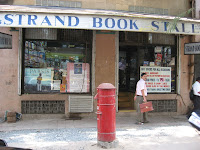
He spoke about some of the people behind the stores. Everyone knows about Mr. Shanbhag of the Strand Books Store. He didn’t go into the details but here is an extract from my post on the Strand Book Festival. “It all started when Mr. T. N. Shanbhag (recipient of the Padmashri in 2003) put up a little stall which sold books at a discount. It was located near the erstwhile Strand Cinema (thus the name) in Colaba and opened on November 20, 1949 and was moved in 1954 to its present location. Mr. Shanbhag was telling me all this and added that he was the first one in the world to sell a book at a discount (that too of 20%)”
Popular Book Depot
He then spoke about the Popular Book Depot and G.R. Bhatkal and his son Sadanand. The Bhatkals were seen as the pioneers of the book and publishing business.
I have had the good fortune of knowing Sadanand kaka as I call him and remember going to the green painted Popular Book Depot on Lamington Road as a kid. The store had a long counter and perpendicular to it, at the back were rows of shelves full of thousands of books. I remember going past these rows to the back and climbing onto a steep ladder to go to Sadanand kaka’s office.
Popular book depot was started by Sadanand Bhatkal’s father Shri Ganesh Bhatkal in 1924. Eminent jurist , the late Nani Palkhiwala in a speech rendered for a G.R. Bhatkal Memorial lecture in September 1995, says that Shri Ganesh Bhatkal helped him in three inestimable ways. He used to allow Mr. Palkhiwala to treat Popular as a public library. During his career as an arts student(1936-1942), he was allowed to sit and browse through books at the shop for hours together and also take home books ‘on approval basis’. He also remembers that he would at times continue reading even after the front door had been closed and later coming out by the back door.
I was truly saddened when Popular closed down in the eighties and so did Bombay Book depot which was a leading Marathi book shop. In fact, Sadanand kaka’s brother Ramdas kaka that ran Popular Prakashan, a publishing house was present for Dr Conlon's lecture.
Dr Conlon ended his lecture by mentioning scholars and institutions that have made a big difference in researching various subjects on Mumbai and feels that today there is an upsurge on the number of people who want to research on Mumbai.
Stores that are still around
Mumbai has various books stores where you can satiate your literary appetite. The new age book stores like Crossword with their flagship store at Kemps Corner and many branches all over,Granth at Goregaon and Juhu, Oxford at Churchgate and the newly opened Landmark at Andheri. All these and the various neighbourhood book stores
There are niche book stores like Marine Sports Books Store at Dadar for sports books, Computer Book Shop on D.N. Road for computer books, Sterling Book Shop at V.T. for management books,Gandhi Book Centre at Nana Chowk for books on Gandhiji,Hindi Granth Karyalaya at C.P. Tank for Hindi books , Ideal book depot at Dadar and Majestic at Girgaum for Marathi books, Lakhani Book Depot at Girgaum for text books and Bhavan's Book stall at Chowpatty and Andheri for Religion,History and Phlosophy.
Single books stores which have been around for a long time like Danai at Khar(which also has opened a branch at the Taj Land's end), Nalanda in the Taj Mahal Hotel at the Gateway of India, Shankars outside Cafe Mondegar on Colaba Causeway and Causeway Book Store which sell books left behind by foreign tourists at over-rated prices.
And the old age ones like the Strand , off P.M. Road, FBH ( Fort Books Distributors) at V.T. who supply a lot of books to all the Mumbai book stores and regularly hold exhibitions all over the city. You would get new and second hand books at the New and Second hand books shop at Metro, Smokers Corner at the Ballard Estate end of P.M. Road and of course the road side book-sellers around Fountain, Churchgate, King's Circle, Bandra and at 'raddiwalas' all over the city. All these stores would always give you discounts on the books.
But in the sea of the Crosswords, Oxfords, Granths and Landmarks … the Strand remains my favorite.
Friday, January 09, 2009
The WSD - "Strays Of Mumbai" Calendar 2009
 The Welfare of Stray Dogs for the first time has brought out the “Strays Of Mumbai” WSD Calendar 2009. The calendar features strays from various parts of Mumbai and catch them in different moods that show what an inseparable part of our lives they are. All the photographs have been taken by WSD volunteer, Rohan Mukerjee.
They are available for Rs 150 at the WSD- Kala Ghoda office and other outlets/vet clinics listed below who have been very kind and generous to stock them.
Proceeds from the sale of calendars go towards WSD’s sterilization and other programmes.
South Mumbai
1) Dogy Articles, Shop No 4, Daulat, Near Colaba Post Office, Colaba, Mumbai Tel: 22162869
2) WSD, C/o Mr F. Broacha, 2nd Flr, Yeshwant Chambers, B.Bharucha Marg, Near Fab India, Kala Ghoda, Mumbai – 23 Tel : 64222838
3) Dr Leena Dalal’s Clinic – Green Fields, Opposite Oval Maidan, Churchgate, Mumbai – 21 Tel: 66153497
4) Ibrahim’s Pet Shop, Kemps Corner, Mumbai – Tel: 23806278
5) Tog Dog, 45, Husain Manor, Petit Road, Breach Candy, Mumbai- 26 Tel: 9820070992
6) Dr Tina Rustomji’s Clinic – Gamadia Polyclinic, Gamadia Colony, Tardeo – Mumbai - 34 Tel: 23519105
Dadar
Dr Makrand Chavan’s Clinic – Shop No 1, Matoshree Tower, Kohinoor Mills Lane, Shivaji Park, Dadar – Mumbai- 28 Tel: 24380756
Bandra
Paws and Furs, Shop No 3, Kailash,156, Waterfield Road, Bandra, Mumbai. Tel: 66990858
Tailwaggers, 16th Road, Behind Hawaian Shack, Bandra, Mumbai. Tel: 9820127572
Khar
KPS My Pet Shop, Shop No 5, Shivanjali, Dr Ambedkar Road, Khar, Mumbai. Tel : 65913333
Chembur
KPS My Pet Shop, Shop No 27, Opp Wasan Motors, Sion-Trombay Rd, Chembur- Mumbai 71 Tel: 6591444
(Please telephone the respective outlet for their timings and availability)
1) Dogy Articles, Shop No 4, Daulat, Near Colaba Post Office, Colaba, Mumbai Tel: 22162869
2) WSD, C/o Mr F. Broacha, 2nd Flr, Yeshwant Chambers, B.Bharucha Marg, Near Fab India, Kala Ghoda, Mumbai – 23 Tel : 64222838
3) Dr Leena Dalal’s Clinic – Green Fields, Opposite Oval Maidan, Churchgate, Mumbai – 21 Tel: 66153497
4) Ibrahim’s Pet Shop, Kemps Corner, Mumbai – Tel: 23806278
5) Tog Dog, 45, Husain Manor, Petit Road, Breach Candy, Mumbai- 26 Tel: 9820070992
6) Dr Tina Rustomji’s Clinic – Gamadia Polyclinic, Gamadia Colony, Tardeo – Mumbai - 34 Tel: 23519105
Dadar
Dr Makrand Chavan’s Clinic – Shop No 1, Matoshree Tower, Kohinoor Mills Lane, Shivaji Park, Dadar – Mumbai- 28 Tel: 24380756
Bandra
Paws and Furs, Shop No 3, Kailash,156, Waterfield Road, Bandra, Mumbai. Tel: 66990858
Tailwaggers, 16th Road, Behind Hawaian Shack, Bandra, Mumbai. Tel: 9820127572
Khar
KPS My Pet Shop, Shop No 5, Shivanjali, Dr Ambedkar Road, Khar, Mumbai. Tel : 65913333
Chembur
KPS My Pet Shop, Shop No 27, Opp Wasan Motors, Sion-Trombay Rd, Chembur- Mumbai 71 Tel: 6591444
(Please telephone the respective outlet for their timings and availability)
Friday, December 12, 2008
Datta Temple at Chowpatty – A Dabholkar Family Heritage


For many years whilst passing Gamdevi towards Chowpatty in a double decker bus, I used to see this old heritage house just before the Bharatiya Vidya Bhavan and wondered who it belonged to. Many years later, I knew that it was not somebody’s home but a Datta(Lord Dattatreya) temple belonging to the Dabholkar family and that it was kept open to the public once a year on Datta Jayanti day.
For years I wanted to visit it and finally, yesterday when I saw the lights and open windows, I asked the watchman standing outside and he said that Datta Jayanti was today and to come early at 7 am to beat the rush.

I am glad that I went there today at 7 am as not only I got to see a 110 year old temple but also had a long chat with Mr. Sachit Dabholkar, the grandson of Shantaram Narayan Dabholkar who built it in 1898 for family use and not for the general public.
The history goes as such… Narayan Dabholkar (the same gentleman after whom a road has been named off Nepean Sea Road where the rich, famous and our ministers live) came to Mumbai from Vengurla with his parents and lived at Sardar Griha, opposite G.T. hospital. (The same place where Lokmanya Tilak used to live). The family was not very well off and after he lost his father to the plague, he had to earn a living. He loved horses and so he started training people on horse riding. He was helped out by a British woman who he was training. Her husband was a Captain in the British army. He got him a job at P & O shipping company where after a lot of hard work and dedication rose up the ranks. Later he started supplying material to the shipping companies and thus became very rich. He used to own a lot of property in Bombay including the place where Bhartiya Vidya Bhavan stands today(their family bunglow was at this very place), bunglows in bhuleshwar and hundreds of square meters of land in Matunga. He also bought a house for 60,000 rupees at Nepean Sea road (on the same road that has been named after him). He had a premonition that he would die at 41 and thus made a will. He died when he was 41 in the same Narayan Dabholkar road house during an inspection of its restoration and repairs when it collapsed on him.
 Due to the immense wealth left behind and due to his immense faith, his son Shantaram Dabholkar built the temple in 1898. The exterior of the temple is built with soft Porbunder stone (now covered with white-wash) which was ideal for carving. The interior has Italian marble floor and Burma teak wood doors and windows. The nine feet tall Devhara (main shrine holder) was ordered from Italy and is made of grey Italian marble. This was ordered by Shantaram Dabholkar in 1897 based on the architectural design m
 ade by him in Mumbai. It had to be shipped in nine parts and assembled here.
This temple was restored in 1998 in its centenary year and was awarded an urban Heritage award (for religious places).
Mr. Sachit Dabholkar who is seventy six years old has been looking after the maintenance of the temple for many years. He estimates that around 14,000 people come on the Datta Jayanti day and he remembers that one year when there was so much rush, even his wife (who is no more) had to wait in the line to get in. He attributes this to the absence of too many Datta temples in the city and also to the immense ‘shraddha’ that people have for Lord Dattatreya and the temple. He knows that there have been many regulars who have been coming there every year for the past 30-40 years and also from far and wide.
When I was chatting with him, I could sense that people had huge respect for this humble gentleman, who was an advertising professional having worked with JWT. He seemed to know everyone who was lining up. They were bowing down at him and he kept telling them pointing towards the Devhara, “bow at Him and not me”.
For years I wanted to visit it and finally, yesterday when I saw the lights and open windows, I asked the watchman standing outside and he said that Datta Jayanti was today and to come early at 7 am to beat the rush.

I am glad that I went there today at 7 am as not only I got to see a 110 year old temple but also had a long chat with Mr. Sachit Dabholkar, the grandson of Shantaram Narayan Dabholkar who built it in 1898 for family use and not for the general public.
The history goes as such… Narayan Dabholkar (the same gentleman after whom a road has been named off Nepean Sea Road where the rich, famous and our ministers live) came to Mumbai from Vengurla with his parents and lived at Sardar Griha, opposite G.T. hospital. (The same place where Lokmanya Tilak used to live). The family was not very well off and after he lost his father to the plague, he had to earn a living. He loved horses and so he started training people on horse riding. He was helped out by a British woman who he was training. Her husband was a Captain in the British army. He got him a job at P & O shipping company where after a lot of hard work and dedication rose up the ranks. Later he started supplying material to the shipping companies and thus became very rich. He used to own a lot of property in Bombay including the place where Bhartiya Vidya Bhavan stands today(their family bunglow was at this very place), bunglows in bhuleshwar and hundreds of square meters of land in Matunga. He also bought a house for 60,000 rupees at Nepean Sea road (on the same road that has been named after him). He had a premonition that he would die at 41 and thus made a will. He died when he was 41 in the same Narayan Dabholkar road house during an inspection of its restoration and repairs when it collapsed on him.
Due to the immense wealth left behind and due to his immense faith, his son Shantaram Dabholkar built the temple in 1898. The exterior of the temple is built with soft Porbunder stone (now covered with white-wash) which was ideal for carving. The interior has Italian marble floor and Burma teak wood doors and windows. The nine feet tall Devhara (main shrine holder) was ordered from Italy and is made of grey Italian marble. This was ordered by Shantaram Dabholkar in 1897 based on the architectural design m ade by him in Mumbai. It had to be shipped in nine parts and assembled here.
This temple was restored in 1998 in its centenary year and was awarded an urban Heritage award (for religious places).
Mr. Sachit Dabholkar who is seventy six years old has been looking after the maintenance of the temple for many years. He estimates that around 14,000 people come on the Datta Jayanti day and he remembers that one year when there was so much rush, even his wife (who is no
 more) had to wait in the line to get in. He attributes this to the absence of too many Datta temples in the city and also to the immense ‘shraddha’ that people have for Lord Dattatreya and the temple. He knows that there have been many regulars who have been coming there every year for the past 30-40 years and also from far and wide.
When I was chatting with him, I could sense that people had huge respect for this humble gentleman, who was an advertising professional having worked with JWT. He seemed to know everyone who was lining up. They were bowing down at him and he kept telling them pointing towards the Devhara, “bow at Him and not me”.
Saturday, December 06, 2008
And Mumbai Came Onto The Streets

On Wednesday, December 3 , 2008 at 6pm, lakhs of Mumbaikars congregated at the Gateway of India to protest about the Mumbai Terror Attacks and also to vent their anger against the politicians…. to convey that Enough Is Enough
 .
. There were young and old, college students and office goers, homemakers and senior citizens, common Mumbaikars and celebrities, people from far and near, children and toddlers …. All their doing their own thing. It was democracy at its best and may be my father's generation would have been reminded of the freedom struggle when people would congregate to demonstrate against the British. There were vocal protests and candle light vigils, huge placards and small ones, signature campaigns and T-shirt declarations, spontaneous Jana Gana Mana renditions and Vande Mataram chants, politician bashing and Pakistan bashing.

The spontaneous outburst was overwhelming and it was amazing to see everyone come there and show that they cared.
The photos below speak more than what I have written above….
The photos below speak more than what I have written above….


Subscribe to:
Posts (Atom)