Sunday, December 31, 2006

Mumbai’s School Sports Day Ground


Everyone who went to school in South Mumbai will definitely remember coming here for their school’s sports day. I am talking about the University Ground officially called the University Sports Pavilion which is located between the Wankhede stadium and the Hindi Vidya Bhavan School on ‘F’ Road. If you commute by the Western Railway you will see this ground just before you reach Churchgate station after you have passed the Marine Lines flyover.

I had gone there today (after many many years) to treat a stray dog who lives there. He saw us and promptly ran into the ground. Being there brought back memories of my school days and I remember spending one day every year out here, cheering class-mates who were taking part in different sports activities an running around on the wooden bleachers carefully avoiding the bigger gaps which had been caused because of the broken bleachers.

The ground is huge and has an athletics track around it. It has the old wooden bleacher seating for spectators’ on one side of the ground. The ground has a nice approach road as one has to walk through a tree-lined path for one length of the ground to get to the spectator stand. The canteen is located behind the stands. The watchman told me that it is busiest in December with Sports Day’s of various schools being held here and is also given out for college and corporate sports events. It is naturally not used during the monsoon.

Today, the stadium needs desperate attention as most of the bleachers were broken in one whole section on the stand. I remember reading reports in the press that a business house was going to sponsor the renovation of the stadium. I just hope that they keep the bleachers and not replace them with concrete seating.

We left the place after leaving medicine for the dog with the watchman in a most appropriate container found lying around. A broken tennis ball!!

Friday, December 29, 2006

James - R.I.P.


James was named so because of Arvind – the boot polishwala whose habit was to name all the strays that lived with him on the footpath outside Eros theatre after the movie that was running at the theatre when he acquired the stray. So James was named after the James Bond movie that was running there and this was sixteen years ago.

James was jet black and his aging grey hair showed prominently on his face. He was one of the lucky few that would have escaped the BMC dogcatchers as he was born much before the BMC stopped the inhumane practice of electrocuting stray dogs. James lived with his companion’s -Pretty, Tipu, S. Raj, Hritik, Amisha and the recent additions of the two Pomeranians. Though all these dogs came into Arvind (and thus James)’s life at different points of time, James was the second eldest in the group after Pretty.


James had a very docile temperament and if you happened to walk down near the Eros theatre at Churchgate, you would see him sleeping on the footpath or trotting back and forth between Eros and Satyam Collections or crouched between the cars parked on the road and the pavement or chasing the crows or following Arvind wherever he went.

James died last week. Though he was old, had lost weight and slowed down, he was still quite fit with good heamoglobin levels, a good kidney and a slightly bad liver. He died after being run over by a car. Arvind who brought him up as a puppy was devastated and still cries remembering him. Now he has only Tipu and the recently acquired Pomeranians left.


James, of course will be dearly missed by everyone including me as I knew him for the past ten years and saw him every Sunday at 9:30 am, as his home is the meeting point of the WSD South Mumbai on-site first aid team.

Friday, December 15, 2006

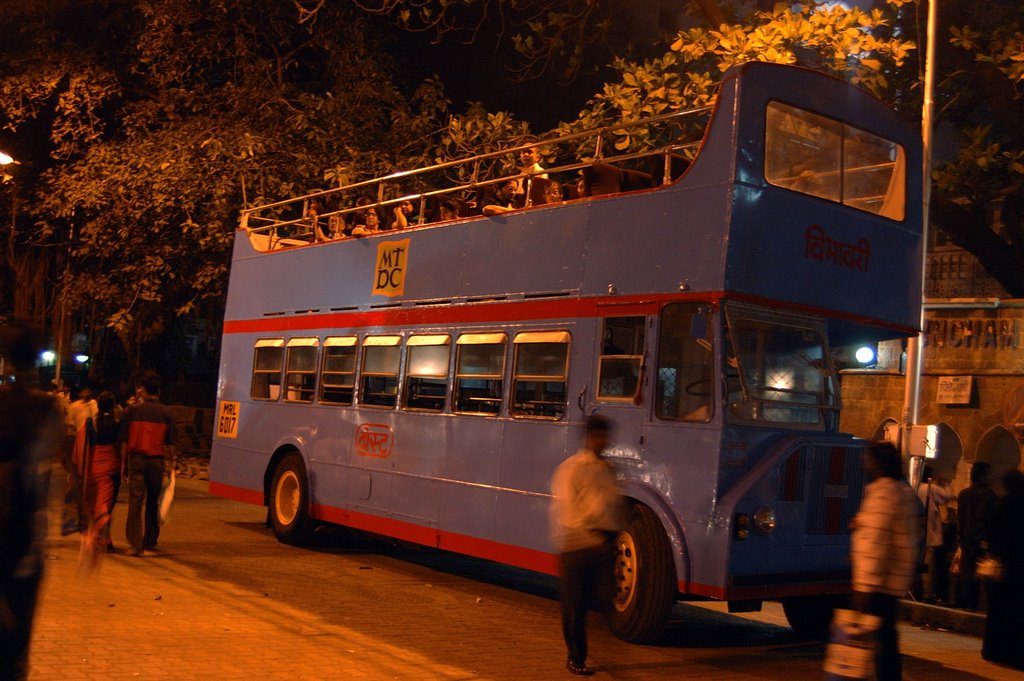
Nilambari-The Open Double Decker Bus Tour

Photo - Courtesy : Rohan Mukherjee
Though the double decker BEST bus has become obsolete, you can still enjoy a ride on an open double decker bus and see the buildings around South Bombay by going on MTDC’s Nilambari, the Open Deck bus service, which leaves from The Gateway of India. The tour is an hour long and is conducted only on Saturdays and Sundays throughout the year (barring the monsoon). It has two services at 7 pm and 8:15 pm.

It is a nice ride and apt for tourists who do not have much time to see the city, for people who like open bus rides and also for Mumbaikar’s who would like to see South Mumbai from around 15 feet high and would like to know about the different illuminated buildings and areas along its route.

The bus commences the tour from the MTDC booth at the Gateway of India (the place where tickets for Elephanta are sold), passes the statue of Shivaji Maharaj, moves along the Gateway of India road past the Taj Mahal hotel and turns onto Colaba causeway towards Regal. It then takes you via the Mantralaya towards Marine Drive, takes a U-turn at the NCPA, past the new Oberoi and runs along a little bit of the Queens Necklace to turn at Jazz by the Bay towards Churchgate station. It turns right at Churchgate round the Oval Maidan, past the University of Mumbai, The Rajabai Tower and the Bombay High Court (all magnificent buildings). It goes along the road behind the Bombay Gymkhana, past the Tata House (now Deutsche Bank building). At the end of the road you see the World Heritage notified V.T.Station (Chattrapati Shivaji Maharaj terminius). It then runs along Dadabhai Naoroji Road past Fountain and turns onto the road, which leads you to the State Bank building past Bombay House (The headquarters of the TATA’s). It passes Horniman Circle, the Asiatic Library and heads back towards the gateway via the Naval Docks road.

You can listen to the guide who gives you a running commentary on the different aspects of the buildings along the route, the history of Mumbai, anecdotes on incidents associated with Mumbai and a little bit their own stuff like “ There across the harbor you can see Malabar Hill, it is said you can buy your mother or father in Bombay but you cant buy a house there, heh heh heh” OR a story on why the Marine Drive is called the Queen’s necklace OR his or her interpretation on which is the better hotel between The Taj and The Oberoi OR he would be pointing towards the BSE and doling out advice on not to buy any stocks as it had reached 14,000 and is definitely going to fall OR how a ‘business house’ painted the ‘Fountain’ and that’s why it has turned green with the moss growing over it. Else you can just ignore the guide and look out and absorb the city. If you are standing up on the Upper Deck, do watch out for the tree branches that might hit you.

Do go early in tourist season as all the Upper Deck seats get taken. The tickets are priced at Rs 90 per person for the Upper deck and Rs 40 for the Lower deck. (No half priced tickets for children and children sitting on the lap are not charged for) It is better to go onto the Upper deck as you can hardly see anything from the Lower deck and you may as well go onto any BEST bus which runs along South Mumbai instead.

Monday, December 04, 2006

Starbus in The City

As a true blue Mumbaikar, I want to try anything that is new in the city. Thus when the BEST launched their new STARBUS, I wanted to get onto it pronto. But, it deluded me for six months as it ran on routes that I never took or never passed through my house, office or kennels. One also could not just jump into it at a signal like other BEST buses as its doors are shut while it is moving. So finally some days ago, I was happy to see a Starbus waiting at the signal outside the Esplanade Court building at Kala Ghoda and as its doors were open, I promptly jumped into it.

At the next stop (opposite the High Court), I heard commuters banging on the door and realized the reason for the doors being open when I got in. The driver had forgotten to shut the door at the earlier stop and thus pressed the button at the bus stop to let the passengers in, only to shut the open door.

The Starbus has two levels and it reminded me of the trailer buses that Bombay had years ago. (Route nos 1, 70, 74) The lower level which is really low almost touches the floor (okay, about one foot higher than the floor) and it can seat 12 people with 3 seats on the side that are foldable and first-timers like me are left wondering how to operate them.

If you are tall, mind your head while climbing the two steps that take you to the higher level. A sign in Marathi, Savdhan, doke aaptel will warn you anyway. The higher level seats 14 people but avoid the last row, as it is terribly hot because of the engine at the back. The bus seats less people than other buses but if you happen to be standing, see that you are holding on dearly to whatever you can get your hands on, as the Starbus is very very unsteady.

Well now for the positives… One big one is that it takes care of the physically challenged. It has a foldable ramp and a place for the wheel chair to be strapped. Another first was that they were playing songs, which I have heard only on public buses and private buses in the South. I though they were playing “In the Summer Time”, only to realize that they were playing a Marathi fusion of Summer Time, They also played some nice old Marathi numbers like ‘he chinche che zaad’, ‘maalyacha malya mandi’, ‘ye jawal ye laju nako’ and ‘aaga ye na, jawal ye na.’ which unfortunately had Jhankar beats.

The bus driver and the conductor were not too happy with the bus. The conductor said that it was used only on short routes and is too shaky. Poor fellow! Must have to put on quite a balancing act. The driver was unhappy that he could not cruise with it through the narrow Jagannath Sunkersett Road in Girgaum as he though it was bulkier than the regular buses.

If you do intend to take a ride on this bus, do read the “In Emergency Instructions for passengers” written there.

1) Press red knob provided near door and open manually.
2) Remove the flap and press handle to open rear door.
3) “Fire extinguishers” near drivers seat at rear end.
4) ‘Break’ rear glass with hammers nearby.
5) Operate “battery cut-off switch’ near driver seat and rear end engine.


So the STARBUS may be suave and foreign looking but the good ole single and double-decker buses are best suited for the hustle and bustle of this city.

Monday, October 23, 2006

Diwali – Then and Now !

Over the years, the way Diwali is celebrated has changed as I see it. Here are some random notings.

Gone are the days when our ‘wadi’ used to have Diwali festivities. Soon gone will be the days when we would have ‘wadis’ left as they would be replaced by some ‘tower’ but that’s besides the point. When we were small, we used to look forward to Diwali, not only for not having to go to school but also for the wadi festivities. They were so popular that all the cousins and relatives of people staying in the ‘wadi’ used to come and spend time with the wadi relatives and participate. The wadi used to be flood lit and a host of events used to be organized. There would be different sporting events arranged including Badminton, Table Tennis, Cricket, Carom and Volleyball tournaments. A play would be staged with the youngsters participating. The highlight of the festivities was arranging an open-air movie show on the ‘parda’. Thus, a white screen used to be put up and a Hindi movie(in black and white) used to be projected on it. Everyone used to sit on chairs or on ‘satranjis’ laid out on the ground and watch it. Our Parsi colony neighbors also used to come into the wadi to watch or watch it from the other side of the screen. I remember seeing Kishore Kumar’s ‘China Town’ on the parda one of the years.

Unfortunately, for many years now these festivities do not take place as many of the wadi youngsters have migrated to the US or are too busy with their own lives.

Diwali at home also meant putting some ‘uttan’ on the ‘pahli anghol’ day and breaking a ‘karit’, putting up lights, making a ‘kandeel’, putting a rangoli and diyas. Faral – the sweets and savories distributed and eaten during Diwali used to be made at home. So one gorged on chiroti, balu shahi, besan, rava and motichur laddoo, karanji filled with a coconut filling, chakli, shankar pali, chivda, shev, kadboli and anarse all throughout the Diwali week. It also meant going out and buying new clothes for yourself and family. On Bhau Beej, my sisters used to perform and Aarti and I had to give them a gift. This custom was carried out to honour the brothers for taking care of them and protecting them, and pray for their well-being. Today, all this has also changed. The faral is home made but bought from some one who makes it at his/her home and is not eaten with as much fervor. As sisters are not in the country, there is no aarti and no gifts to give. The lights are still put on but the kandeel is bought from the market.

Diwali in the city has changed too. If you took a bus from V.T. thru Girgaum thru Parel to Mahim, you would see many chawls and buildings having similar colored kandeels(lanterns) put up in a row on the long balconies. Today, many of these chawls have been pulled down. In fact our ‘wadi’ too had this uniform code as far as the Diwali lights were concerned. There would be nine ‘zero’ bulbs with a set pattern of colors. Red at one end, then green, then yellow, then orange and white in the middle and the same repeated on the other side. Thus all the flats in the wadi used to have the same kind of Diwali lights put up on their balconies. Today barring a few nobody follows this code. The kandeels too have changed. Unfortunately, more and more people have started buying plastic kandeels which not only are bad for the environment but also look terrible and tacky.

If you go to Marine Drive, the sky is lit up with firecrackers. It seems that the whole of Bombay descends on Marine Drive to either burst the crackers or to see the fireworks display. I remember one year on Diwali day as I was waiting for a 123 BEST bus, I was pleasantly surprised that the 123 was an open-top double decker bus and when it went onto Marine Drive, one could see the firework display right above you. Though, I am sure Marine Drive residents must be having a tough time during Diwali.

Of course, over the years with people becoming more aware of noise and air pollution and the judiciary stepping in, one hears fewer crackers than 15 years ago. This is a welcome sign not only for us but also for the animals – stray dogs, cats, and pets etc that all have a bad time during Diwali. They go through immense trauma because of the crackers and every year the number of road accidents, burn cases and pets that get lost are very high

I wonder what further changes would happen twenty years hence in the way people celebrate Diwali, maybe it would be celebrated on the net only and through blogs ??

Monday, October 02, 2006

Gandhiji and Bombay


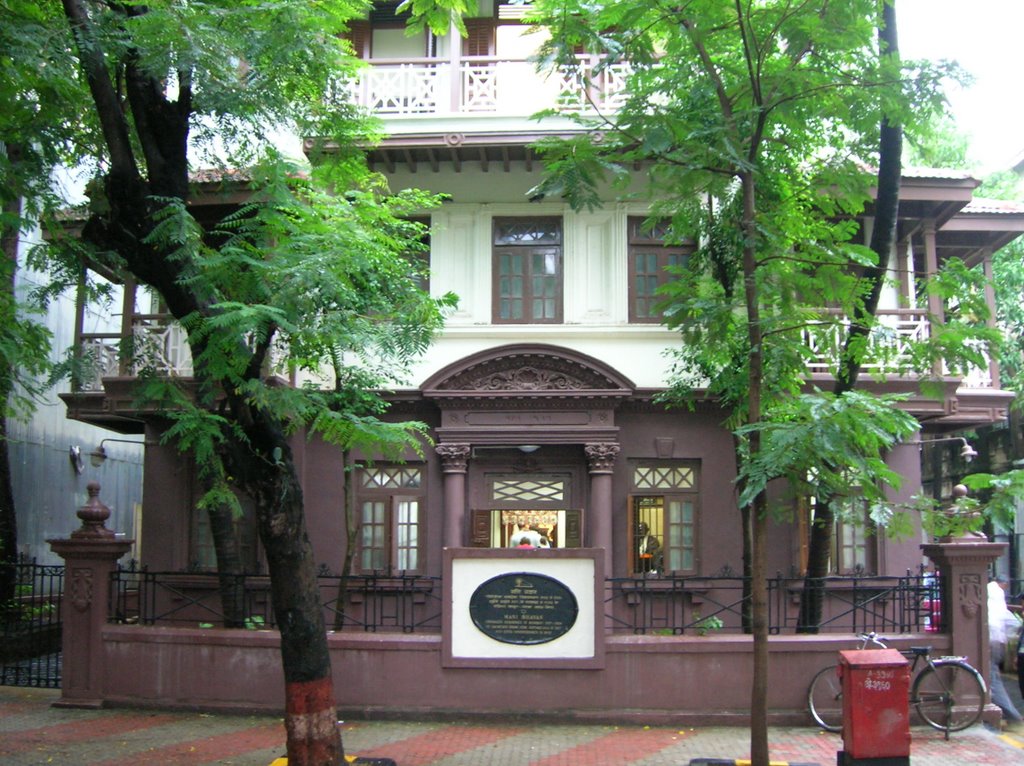
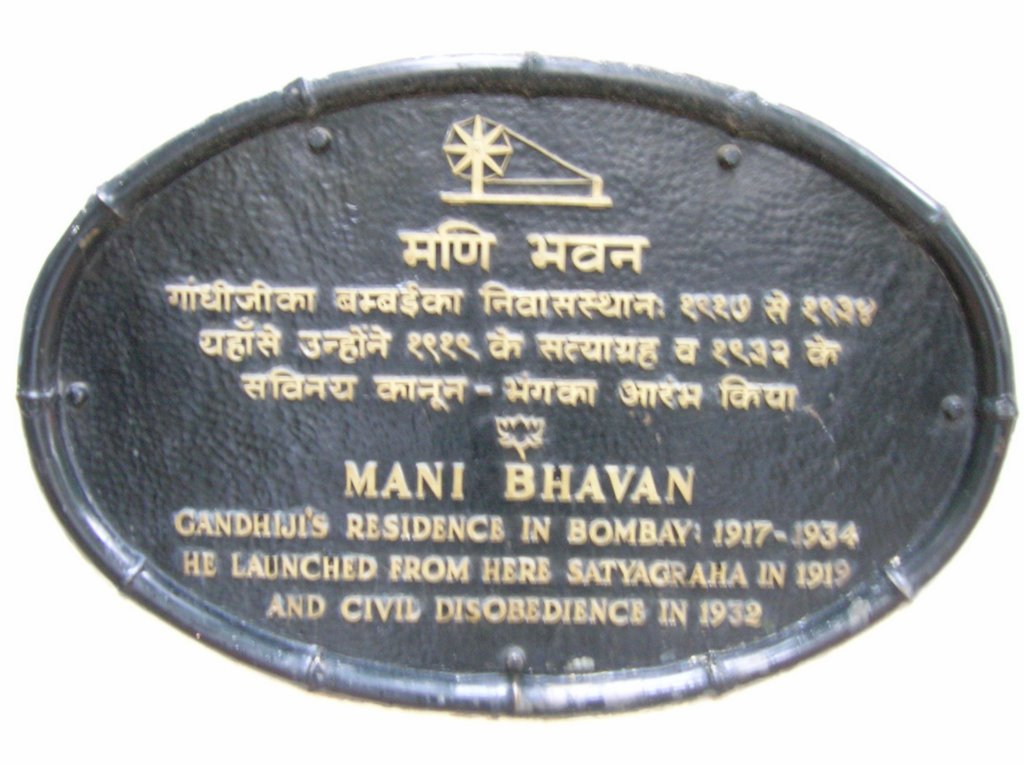
The above photograph of Gandhiji was taken on his return to Bombay from South Africa in 1915. Thus, on Gandhi Jayanti day, if one has to remember places that bring out Gandhiji’s association with Bombay, the most important would be Mani Bhavan,now a memorial museum at Laburnum Road, Gamdevi that served as his headquarters from 1917-1934.

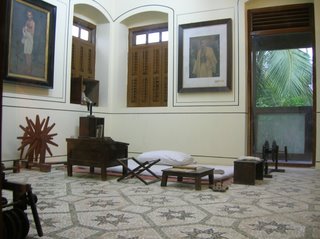
Bombay, a city in the forefront of the freedom struggle had attracted Gandhiji often and he used to stay in the city at the residence of Shri Revashanker Jhaveri’s Mani Bhavan. It is a two-storied building, with the ground floor housing a library and the first floor has a picture gallery and an auditorium. On the second floor, you can see the room where Gandhiji worked out of and also various photos, memorabilia and letters. It also has an exhibition on his life called Glimpses of Gandhi, which shows the important events in Gandhiji’s life in a mini-figures format. Mani Bhavan attracts many tourists but I wonder how many Mumbaikars have visited it.

Gandhiji's room at Mani Bhavan

These are some of the activities that Gandhiji carried out in Bombay

# In 1917, he took the first lessons in carding from a carder who used to pass Mani Bhavan every day.
# He learnt spinning here.
# The Satyagraha movement against the Rowlett Act was launched from here in March 1919.
# He took over the writing of two magazines Young India and Nava Jeevan in 1919.
# He lent support to the Khilafat movement from here in 1920.
# He participated in the funeral procession of Bal Gangadhar tilak from Sardar Griha to Chowpatty in 1920. His words " A great among men has fallen" are remembered by all.

# The decision to collect one crore rupees from the Tilak Swaraj Fund was taken and its start made here in 1921.
# He organized the boycott and bonfires of foreign cloth from here on July 31,1921.
# He was arrested from his tent on the terrace of Mani Bhavan on Jan 4, 1932.
# His last stay at Mani Bhavan was on June 17-18 1934.

Various statues Of Gandhiji exist in Mumbai, the most prominent being the one at Mantralaya. As all cities Bombay has an M.G. Road, in fact more than one. The most prominent being the one from Metro to Kala Ghoda. The others are in Goregaon (W) and Ghatkopar. Various organisations like the Bombay Sarvodaya Mandal at Nana Chowk spread his teachings and sell books on Gandhiji.

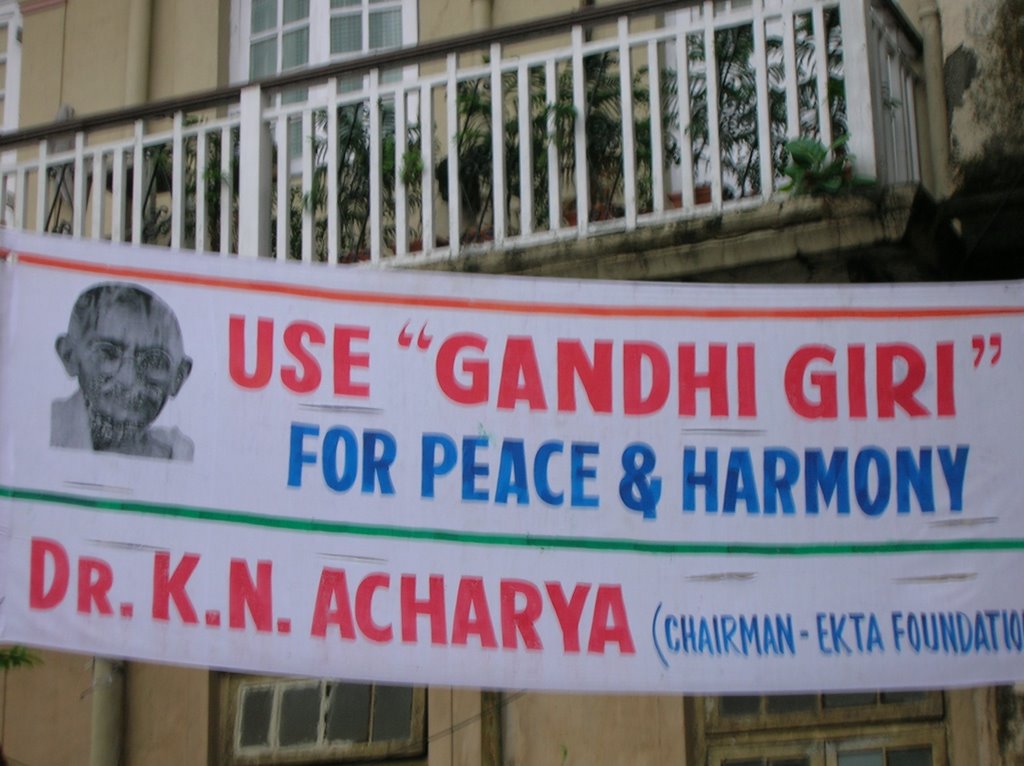
As I was leaving Mani Bhavan, I smiled seeing a banner on the opposite side on the road “Use Gandhigiri, For Peace and Harmomy”. Gandhiji is also being remembered at many of the theatres in Mumbai that are playing the film “ Munnabhai”.