Showing posts with label History. Show all posts

Friday, March 05, 2010

Kipling at the J J School of Art.


When I was in school, I used to go into the dean’s bungalow in the campus of the Sir J J. Institute Of Applied Art and collect ‘gunja’ or the red beads that fell into its compound from the red sandalwood / bead tree also referred to as Ratangunj in Marathi. In olden times, it is said that goldsmiths used to use these red beads as weights.

My visits were because of the fact that I studied at the next-door St Xavier’s High School and used to visit my sister who was a commercial arts student at the J.J School. Many years later as I developed an interest in Mumbai’s history, I came to know that the dean’s bungalow where we collected the red beads was historic as the well known Scottish born author and poet Rudyard Kipling was born here on December 13, 1865. Of course, the bungalow in which he was born was pulled down and another (shown below) was built in its place.


Rudyard’s father, John Lockwood Kipling was the first Principal of the J.J. School of Art. The J.J. School was funded by Sir Jamshedji Jeejeebhoy, designed by George Twigge Molecey and opened in 1857 with additional buildings constructed between 1878 and 1907. Eminent architect, George Wittet who also taught at the Architecture school designed the School Of Architecture building. He has designed other Mumbai buildings like The Gateway of India, Prince Of Wales Museum (now Chattrapati Shivaji Maharaj Vastu Sangrahalaya), G.P.O., Institute of Science, The Small Causes Court and Wadia and K.E.M Hospitals.

Here’s what Kipling wrote about Bombay in his ‘To the city of Bombay

The Cities are full of pride,
Challenging each to each --
This from her mountain-side,
That from her burthened beach.

They count their ships full tale --
Their corn and oil and wine,
Derrick and loom and bale,
And rampart's gun-flecked line;
City by City they hail:
"Hast aught to match with mine?"

And the men that breed from them
They traffic up and down,
But cling to their cities' hem
As a child to their mother's gown.

When they talk with the stranger bands,
Dazed and newly alone;
When they walk in the stranger lands,
By roaring streets unknown;
Blessing her where she stands
For strength above their own.

(On high to hold her fame
That stands all fame beyond,
By oath to back the same,
Most faithful-foolish-fond;
Making her mere-breathed name
Their bond upon their bond.)

So thank I God my birth
Fell not in isles aside --
Waste headlands of the earth,
Or warring tribes untried --
But that she lent me worth
And gave me right to pride.

Surely in toil or fray
Under an alien sky,
Comfort it is to say:
"Of no mean city am I!"

(Neither by service nor fee
Come I to mine estate --
Mother of Cities to me,
For I was born in her gate,
Between the palms and the sea,
Where the world-end steamers wait.)


Now for this debt I owe,
And for her far-borne cheer
Must I make haste and go
With tribute to her pier.


And she shall touch and remit
After the use of kings
(Orderly, ancient, fit)
My deep-sea plunderings,
And purchase in all lands.
And this we do for a sign
Her power is over mine,
And mine I hold at her hands!

                                                                                                                                  Gillian Tindall in her book, 'The City of Gold' clarifies the reason why Kipling used the words “between the palms and the sea”. “When Kipling was born land – reclamation was only just beginning and the bay beyond the railway lines wasn’t yet filled up by the then Alexandra (now Indira) docks. The railway itself was a newcomer. The V.T.Terminus (now C.S.T) was not yet built and instead there was a small station called Bori Bunder named after an old wharf. So the Kiplings’ bungalow, with the trees of the maidan behind it could literally have been described as ‘between the palms and the sea’.

Another Rudyard Kiplings’ Mumbai connection is that of the beautifully sculpted marble panels in bas-relief on the Crawford market and the decorative panel of tutelary animals and the Indian River Goddess on the fountain inside the Crawford Market. They were crafted by Rudyard Kipling’s father, John Lockwood Kipling.

Coming back to the bungalow, currently it is lying vacant and there was some talk about it being converted into a Museum but not naming it after Kipling. Hope they preserve the bungalow and if you have the time take a stroll into the beautiful J.J. School campus and look it up like so many foreign tourists who come clutching a copy of The Lonely Planet asking for directions of the Kipling bungalow.

Wednesday, February 18, 2009

Bombay's Book Stores - Old and New

Today, when I saw Dr Frank Conlon at the Durbar Hall at the Asiatic Society, I remembered where I had seen him last. It was at the St Xavier’s College in February 2007 where he was giving a lecture on The Tramways of Mumbai. This time, he was talking about “Bombay’s Book Sellers and scholars”, a talk organized by The Asiatic Literary Society.


Dr Frank has written many Bombay centric articles including "Dining Out In Bombay", "Industrialization and the Housing Problem in Bombay, 1850-1940” and the book, "A caste in a changing world : the Chitrapur Saraswat Brahmans, 1700-1935".

He first came to Mumbai in November 1965 and frequented many book stores and libraries. He remembers book stores like Taraporewala and Sons and New Book Company on D.N. Road, Thackers and Chetana on Rampart Row, Alavi Book Depot and Kokil on Mohammed Ali Road, N.M. Tripathi on Princess Street, New and Second Hand book store at Kalbadevi, Popular Book Depot on Lamington Road and Bombay Book Depot at Prarthana Samaj and the Strand Book Stall in Fort.

He says that the above stores were started by people who had genuine appreciation of books. Real books shops are an ‘endangered’ species today and various compulsions have closed down many including Popular, Bombay, Thackers, Alavi and Kokil.

He added that today’s bookstores like Crossword might be fancy, have sofas, carpets, air-conditioners and coffee shops but the people working there have ‘no engagement with the product’ and going to such stores is not the same for those who feel and have a special affection for books.

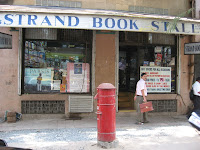
Strand Book Stall

He spoke about some of the people behind the stores. Everyone knows about Mr. Shanbhag of the Strand Books Store. He didn’t go into the details but here is an extract from my post on the Strand Book Festival. “It all started when Mr. T. N. Shanbhag (recipient of the Padmashri in 2003) put up a little stall which sold books at a discount. It was located near the erstwhile Strand Cinema (thus the name) in Colaba and opened on November 20, 1949 and was moved in 1954 to its present location. Mr. Shanbhag was telling me all this and added that he was the first one in the world to sell a book at a discount (that too of 20%)”

Popular Book Depot

He then spoke about the Popular Book Depot and G.R. Bhatkal and his son Sadanand. The Bhatkals were seen as the pioneers of the book and publishing business.

I have had the good fortune of knowing Sadanand kaka as I call him and remember going to the green painted Popular Book Depot on Lamington Road as a kid. The store had a long counter and perpendicular to it, at the back were rows of shelves full of thousands of books. I remember going past these rows to the back and climbing onto a steep ladder to go to Sadanand kaka’s office.


Popular book depot was started by Sadanand Bhatkal’s father Shri Ganesh Bhatkal in 1924. Eminent jurist , the late Nani Palkhiwala in a speech rendered for a G.R. Bhatkal Memorial lecture in September 1995, says that Shri Ganesh Bhatkal helped him in three inestimable ways. He used to allow Mr. Palkhiwala to treat Popular as a public library. During his career as an arts student(1936-1942), he was allowed to sit and browse through books at the shop for hours together and also take home books ‘on approval basis’. He also remembers that he would at times continue reading even after the front door had been closed and later coming out by the back door.

I was truly saddened when Popular closed down in the eighties and so did Bombay Book depot which was a leading Marathi book shop. In fact, Sadanand kaka’s brother Ramdas kaka that ran Popular Prakashan, a publishing house was present for Dr Conlon's lecture.

Dr Conlon ended his lecture by mentioning scholars and institutions that have made a big difference in researching various subjects on Mumbai and feels that today there is an upsurge on the number of people who want to research on Mumbai.

Stores that are still around

Mumbai has various books stores where you can satiate your literary appetite. The new age book stores like Crossword with their flagship store at Kemps Corner and many branches all over,Granth at Goregaon and Juhu, Oxford at Churchgate and the newly opened Landmark at Andheri. All these and the various neighbourhood book stores

There are niche book stores like Marine Sports Books Store at Dadar for sports books, Computer Book Shop on D.N. Road for computer books, Sterling Book Shop at V.T. for management books,Gandhi Book Centre at Nana Chowk for books on Gandhiji,Hindi Granth Karyalaya at C.P. Tank for Hindi books , Ideal book depot at Dadar and Majestic at Girgaum for Marathi books, Lakhani Book Depot at Girgaum for text books and Bhavan's Book stall at Chowpatty and Andheri for Religion,History and Phlosophy.

Single books stores which have been around for a long time like Danai at Khar(which also has opened a branch at the Taj Land's end), Nalanda in the Taj Mahal Hotel at the Gateway of India, Shankars outside Cafe Mondegar on Colaba Causeway and Causeway Book Store which sell books left behind by foreign tourists at over-rated prices.


And the old age ones like the Strand , off P.M. Road, FBH ( Fort Books Distributors) at V.T. who supply a lot of books to all the Mumbai book stores and regularly hold exhibitions all over the city. You would get new and second hand books at the New and Second hand books shop at Metro, Smokers Corner at the Ballard Estate end of P.M. Road and of course the road side book-sellers around Fountain, Churchgate, King's Circle, Bandra and at 'raddiwalas' all over the city. All these stores would always give you discounts on the books.

But in the sea of the Crosswords, Oxfords, Granths and Landmarks … the Strand remains my favorite.

Saturday, August 25, 2007

Food with a Mumbai 'chaap'

Many years ago when the dosa wala near August Kranti Maidan was sprinkling soya sauce and noodles onto a sada dosa calling it Chinese dosa, I could believe it as this is what Mumbai does to its food. She invents it here, hands it over to the others and doesn’t even patent it. This is just what happened to Nelson Wang’s Manchurian and we have many examples of Mumbai introducing quintessential food and leaving a Mumbai chaap to it. And that is more than our Vada Pav, Pav Bhaji and Bhel which has got its due and is dished out in many towns as Bombay Bhel or Bombay Pav Bhaji.

The Iranis might have brought the know how of baking from Iran but the Bun Maska ( soft , sweet bread with butter), Brun Maska ( hard bread with butter) and Khari would still remain Mumbai brands. Bomi Hormusji Irani whose grandfather started B. Merwan and Co at Grant Road confirms this and says “ You will find the Brun , Bun and Khari ninety percent in Mumbai only” He says that these must have been introduced somewhere between 1910-1914 when Irani café’s were being set up. .

One more drink very distinctive to Mumbai and to Pune is Raspberry which was introduced by Parsi owned beverage companies like Dukes, Rogers and Framroze & Co in the early 1900’s. This is a dying brand whose availability today is restricted to Parsi weddings and some Irani Cafés.

Juices like Ganga Jamuna , a mix of orange and sweet lime juice and Mara Mari, a mix of sweet lime and pineapple were introduced in Mumbai in the seventies says Ramesh Sondarva, one of the oldest employees of Bachelor’s at Chowpatty which claims to be the oldest juice centre in Mumbai. These were introduced long after the juice outlet opened in 1940. Shekhar Pujari of Sukh Sagar Juice centre adds that it was due to ‘public demand’ that they started serving these two cocktails. The name Ganga Jamuna might draw a parallel from the confluence of two rivers as both the fruits come from the same Citrus family. Mara Mari might have been due to mixing of two fruit juices from different fruit families.

And lastly good ol’ Cutting chai which may be another name for tea but has a unique Mumbai chaap to it. The road-side tea stall in Pune would serve you Amrutulya chaha but the consumption of Mumbai’s cutting chai which actually means cutting one chai into two, not only makes it lighter on the pocket but also lets you finish it off very quickly so that you can get hurriedly refreshed and set off to keep up with Mumbai’s rapid pace.

Wednesday, August 22, 2007

Mumbai's 'gaons'

A little history, lest we forget three Mumbai neighborhoods which were villages that have long been integrated with Mumbai’s urban present and the only thing gaon-ish about them today is their ‘gaon’ tag.

Mazgaon: Mazgaon was an ancient Portuguese township and the name was either derived from Maza gaon which means my village in Marathi or from Maccha Grama which means a fishing village. It was also one of the original seven islands that Mumbai comprised of. Not many would know but Mazgaon was also famous for its mango trees which used to bear fruit twice a year. The Mazgaon mango was a celebrated commodity and finds a mention as the ‘Mangoes of Mazagong’ in the epic poem Lallah Rookh written by Thomas Moore in 1817. Mazgaon was home to many old stone houses and wooden bungalows, built in the eighteenth and early nineteenth centuries which were inhabited by mostly the Britishers and Parsis. Gunpowder Lane near Matharpacady was so called as a result of the armoury being moved to this area. Prominent landmarks in Mazgaon today are the Sales Tax office, the Mazgaon court and the Matharpacady village, a heritage ‘quartier’ with quaint, old houses struggling to survive amidst the skyscrapers in the neighbourhood.

Girgaon: The name literally translates into hill village. Giri in Marathi means hill. Thus, this was the village that existed at the foot of the Malabar Hill and is said to have been inhabited in the mid-nineteenth century. Girgaon comprised Girgaon woods and also boasted of coconut and mango groves and vast areas of plantations called wadi in Marathi. Today the Girgaon wadis may not be cultivating any of the produce that they used to but names like Mugbhat, Phanaswadi, Kelewadi, Kandewadi and Ambewadi would suggest the kind of plantations that must have existed there. Likewise, Zaoba Wadi, Vaidya Wadi, Khotachi Wadi & Jitekar Wadi may suggest who they belonged to. Gai Wadi was so named because of the large presence of cow sheds. Girgaon still has retained some of the villagish charm with its narrow lanes and old houses but times are changing. Many chawls in Girgaon with long wooden balconies are making way for multi storied buildings. Some old Maharashtrian restaurants like Kulkarni famous for its batata bhajiya, Virkar, Tembe Vishranti Gruha and many khanawals have shut down. Others like Chhatre‘s Kolhapuri Chivada, Vinay Health Home and B. Tambe have changed with the times and got renovated.

Goregaon: One version says that Goregaon was named after the Gore family who were active in politics. Another, which seems more accurate, says that the meaning translates into ‘white village’ in Marathi, as it was a large milk-producing centre since olden times. The Goregaon (E) area has still remained one of the few Mumbai’s green lungs in spite of the fact that the Aarey Milk Colony was set up in 1949 by acquiring 3000 acres of forest land. This was one of the world’s largest dairy farms and would be used to organize the supply of pasteurized bottled milk to the city. Many cattle from congested parts of the city were shifted here. The Film City was also set up here in 1978. Goregaon has now become another Mumbai suburb with a burgeoning population and various colonies or ‘nagars’, many high rise buildings, malls and multiplexes.

Saturday, May 12, 2007

Bhau, Nana & Rajabai

Many places in Mumbai have been named after Indians who have contributed to this city’s infrastructure. We have heard, passed through or visited these places but may not know who the people affectionately called Nana or Bhau were. Here are three such places.

Bhaucha Dhakka

Bhaucha Dhakka or Ferry Wharf was built by Lakshman Hari Chandarjee Ajinkya. (1789-1858). He belonged to the Pathare Prabhu community (one of the original inhabitants of Bombay).He was affectionately addressed as Bhau or big brother by the local people. His family had estates at Naigaum and Parel and he worked as Chief Clerk in the Gun Carriage Factory in Colaba. Information given in the Govt. Archives and in the Marathi book ‘Pathare Prabhuncha Itihaas’ by Pratap Velkar reveal that Bombay did not have a regular pier or wharf till 1835 for either goods or passengers. The government started leasing out land on the Bombay frontage to private individuals to build wet docks and basins. Laksman Hari Chandarjee Ajinkya alias ‘Bhau’ was the first local to take this opportunity. He thus constructed Bombay’s first wet dock in 1841 for the convenience of the passengers and incoming ships to load, embark and berth. These included Carnac and Claire bunders. Today, the passenger terminal at the Bhau-Cha-Dhakka is still used to ferry people to Mora and Rewas for their onward journeys to Uran and Alibag.

Nana Chowk

This very busy traffic junction which has six roads converging into it is named after Jagannath Shankersett alias Nana. (1803-1865). He owned large areas of land in the Nana Chowk area including a ‘wada’ which now has been replaced by high rise buildings, the recent Sunkersett Palace and another Sunkersett Mansion built decades ago. This area also has an old privately restored Bhavani Shankar temple built in 1806 associated with the Sunkersett family. JSS was born in a wealthy family of goldsmiths and contributed in many ways towards this city including donating land for the Royal/Grant Road theatre and endowing schools. In 1845, along with Sir Jamshejee Jeejeebhoy
, he formed the Indian Railway Association which was eventually incorporated into the Great Indian Peninsular Railways (GIP).They were the only two Indian directors out of the other ten in the GIP railways. He was also the first Indian member of The Asiatic Society and you will find his full size marble statue at the Asiatic Society Library. The erstwhile Girgaum road which extends from Opera House upto Princess Street is also named after him. A postage stamp was also issued in his honor in 1991.

Rajabai Tower
Rajabai tower located in the campus of the University of Mumbai at Fort including the library was built at a cost of over six lakh rupees donated by Premchand Roychand (1831-1906). Both these structures were designed by Sir Gilbert Scott and completed in 1878. The 280 feet high tower with a clock was a tribute to his mother, Rajabai. Premchand Roychand was a prominent banker and philanthropist of the 19th century who supported many schools especially for the education of girls. The schools included J.B.Petit High School, Bombay Scottish Orphanage School, Alexandria School and Cathedral Girls School. The Premchand Roychand gallery at the Chhatrapati Shivaji Maharaj Vastu Sangrahalaya (Museum) has been named in his memory and it recently hosted the Bombay Bonanza exhibition to commemorate his 100th death anniversary. It must be noted that there is no statue of him in Mumbai nor any Mumbai street bears his name.

Tuesday, April 10, 2007

Cafe De La Paix


Did you know that we have a little Irani café at Girgaum whose name was inspired by the famous 1862 opened Café De La Paix (pronounced – pay) located at place de l'Opéra in Paris and designed by architect Charles Garnier. The story goes that when the owner, Mr. Irani opened this café in 1932, the landlord of his building had just been to Paris and had been greatly impressed by the Café De La Paix there. So he requested him to give this name to the Irani café he was opening. It is located at the corner of Avantikabai Gokhale Road, which has the bustling auto spare parts market. And don’t worry; our Café De La Paix will serve you bun maska and chai at much more affordable rates than its Paris namesake.